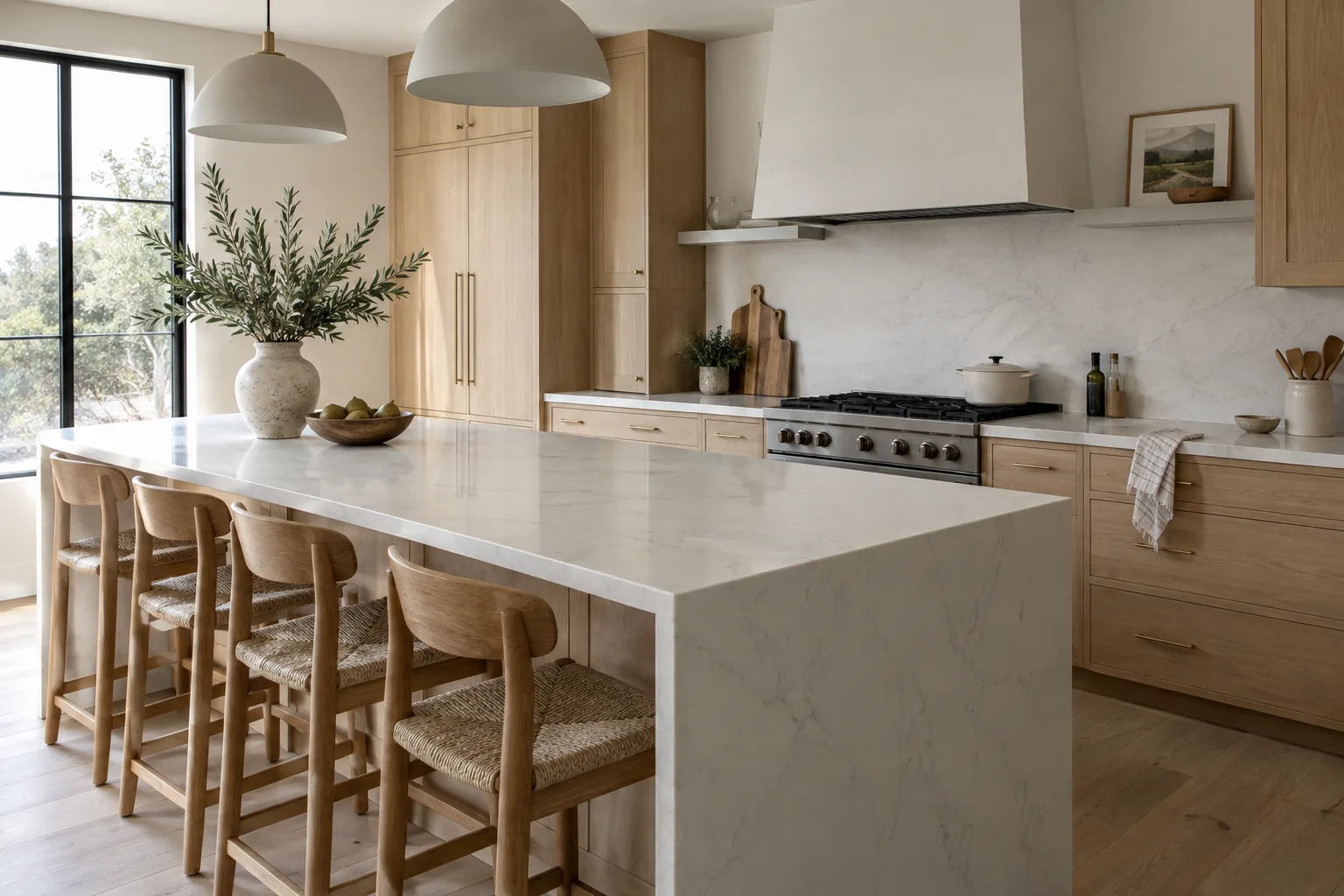
Gas or electric cooktop
A rectangular opening with rounded corners, sized to the unit's flange, with enough clearance to the wall and to the cabinet below for the burner box.

Henderson Custom Countertops handles countertop cutouts for cooktops, downdraft vents, drop-in ranges and built-in appliances in Hendersonville, NC. We work from the maker's installation sheet for your exact model, so the unit drops in square and the stone stays strong around it.
An appliance cutout is any opening in the stone made to receive a built-in unit, and each unit has its own required size, clearance and support. Cooktops are the most common, but the list also includes downdraft vents, drop-in ranges, flush-mounted units and beverage or warming equipment set into a top.
We take these jobs for kitchens in Hendersonville, Flat Rock, Laurel Park and Mills River, as part of a new top or on its own. The sheet that comes with your appliance, or its model number, is the one thing we need most, so please have it ready when we visit.
Why Henderson Custom Countertops
Whoever measures your cabinets is the person accountable for the finished top.
Every built-in appliance ships with an installation sheet that states the cutout size, the corner radius and the clearances, and that sheet overrides any rule of thumb. A quarter inch too small and the unit will not seat; too big and it may sit crooked, leave a gap or lose its support.
Clearances are as important as the opening itself. A cooktop needs space to the wall behind it, to a combustible surface, and to the cabinet below, and its heat output and gas or electric supply differ by brand. We read these numbers before we draw, and we tell you when a layout you had in mind does not meet them.
The sheet usually covers:
If you have not chosen the appliance yet, hold off on the template, or tell us the two models you are choosing between. We would rather wait a day than cut for one unit and install another.
Each type of unit sits in the stone differently, and that changes how we cut and finish the edge. Knowing which type you have tells us how much stone has to stay around the opening.
A drop-in cooktop rests on a flange that overlaps the stone, so the edge of the cut is hidden and does not need the same polish as an exposed one. A flush-mount cooktop is set level with the surface, which means the cut edge is visible and must be finished with the same care as a sink opening. A slide-in or freestanding range needs no cutout in the stone at all, only a clear space between cabinets, though the countertop must be square and level around it.
A downdraft unit is more demanding, because it needs a narrow slot cut at the back or beside the cooktop, and that slot removes stone close to the edge. The slot, the ducting below and any raised vent can limit where a seam can sit.
Points we check with you:
The details change from model to model, which is why we do not quote a generic opening for any of them.
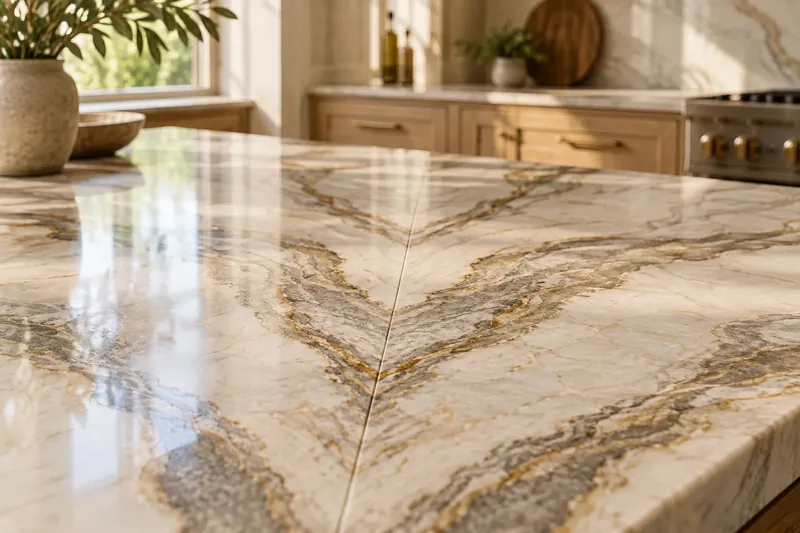
A standard cooktop cutout is usually estimated at about $100 to $300 on top of the countertop price, and more specialized openings run higher. Treat that as an estimate; the final figure comes only from the written quote you get once we have measured.
A short guide, all estimated:
The cost grows with the amount of cutting and polishing, not with the price of the appliance. A cheap cooktop in a hard stone can cost more to cut than an expensive one in a soft stone, because the saw works longer.
Edge finish is the biggest swing. An opening that stays hidden under a flange is quick; one that is visible, like a flush cooktop or an exposed appliance front, must be ground and polished. The stone type also matters, since a thick, dense quartzite wears blades faster than most other materials.
If you are weighing two appliances, tell us both models and we will estimate each, so you know whether a design choice changes the stone bill.
Every cutout takes stone away, and the leftover stone beside it is what carries the load, so we plan openings to protect strength. The weakest spots on a top are the narrow strips beside an opening and the inside corners, and most cracks start in one of those two places.
Four habits help:
Heat is the other concern. Stone expands, and a hot pan set down at the edge of a cooktop opening can make a hairline crack spread, so manufacturers specify a gap between the burner and the stone. We keep to that gap and do not widen or tighten it.
We also drill and cut for the little things that tend to be forgotten: a hole for a vent or a switch, a pop-up outlet, a dispenser, a pass-through for a cord. Tell us now, because adding a hole after the install risks the whole top.
Gas, electrical and venting connections are left to the licensed trades. We make the opening and set the stone, and your installer completes the hookup.
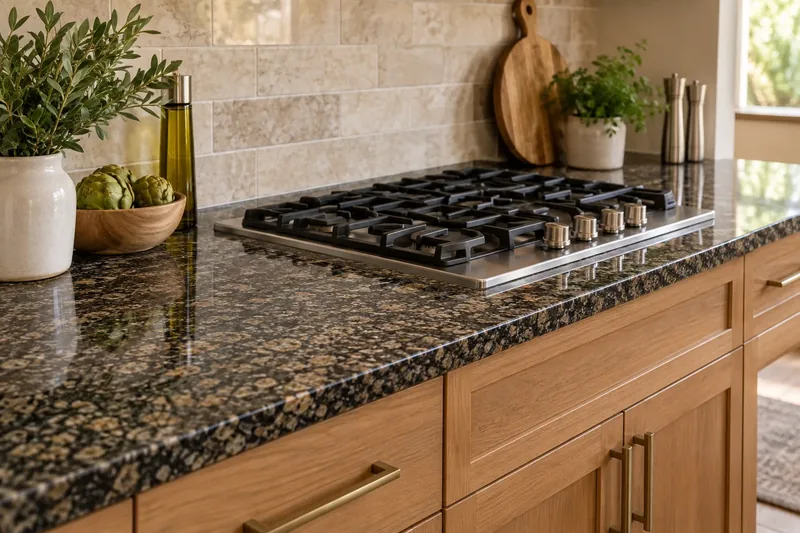
These are the common appliance and fixture openings in a kitchen top, with what we watch for in each.
A rectangular opening with rounded corners, sized to the unit's flange, with enough clearance to the wall and to the cabinet below for the burner box.
A flatter, lighter unit that needs air space below for its fans. We confirm the depth of the cabinet and the vent path before we cut.
A slim slot cut beside or behind the cooktop that connects to ducting beneath. It leaves less stone at the edge, so we position it with care.
Round or rectangular openings for outlets, dispensers and faucets, drilled in the shop to a clean, polished finish.
Start to finish
The model and its sheet are confirmed before the slab is touched.
You give us the model number or the installation sheet, and we confirm the cutout size and clearances.
We mark each opening on the template and check it against the cabinet below and any nearby seam.
Each opening is machined in the shop with radiused corners, and any edge that will show gets ground and polished.
We set the stone and try the unit in the opening, so it is checked before your installer's hookup.
Straight answers
We need the exact model number, or better, the installation sheet that came with the appliance. It lists the opening size, the corner radius and the clearances we cut to.
We can plan around two or three candidates, but we cut only for the one you choose. Sizes vary by model, so cutting for a guess risks a unit that does not fit.
No. A slide-in or freestanding range sits between cabinets, so the stone just needs a clean, level run on each side. Drop-in and flush-mount cooktops are the ones that require an opening.
A standard cooktop cutout is typically estimated at about $100 to $300, with flush-mount and downdraft openings costing more. The written quote after the measure sets the final price.
Not when it is done right. Cracks start at sharp inside corners and thin strips, so we round the corners, keep openings away from seams and leave enough stone between them.
Sometimes. We look at how much stone remains around the old opening and whether the new unit fits within it. If the opening has to grow, we check the strength first, and we say so if a new top is the safer route.
No. We cut the opening and set the stone, and a licensed gas fitter or electrician makes the connection. We schedule our install so the trades are not waiting on each other.
It is better to plan them with the rest of the top. A hole drilled after install risks the surface, and a polished edge is harder to get on site, so tell us before the template.
Give us your appliance models and we will book a site visit in Henderson County.
Licensed, bonded & insured. Calls only, we do not receive text messages.