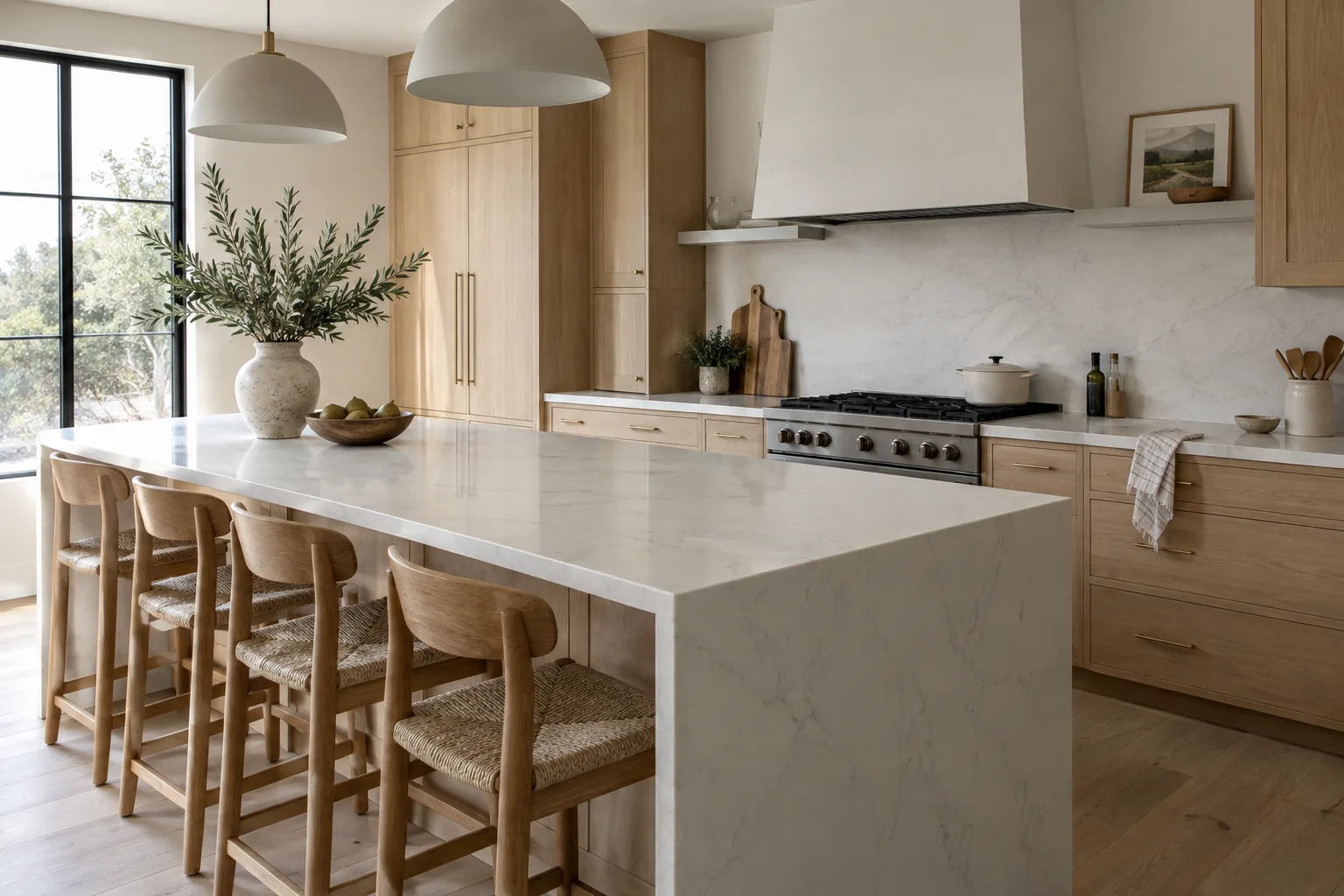
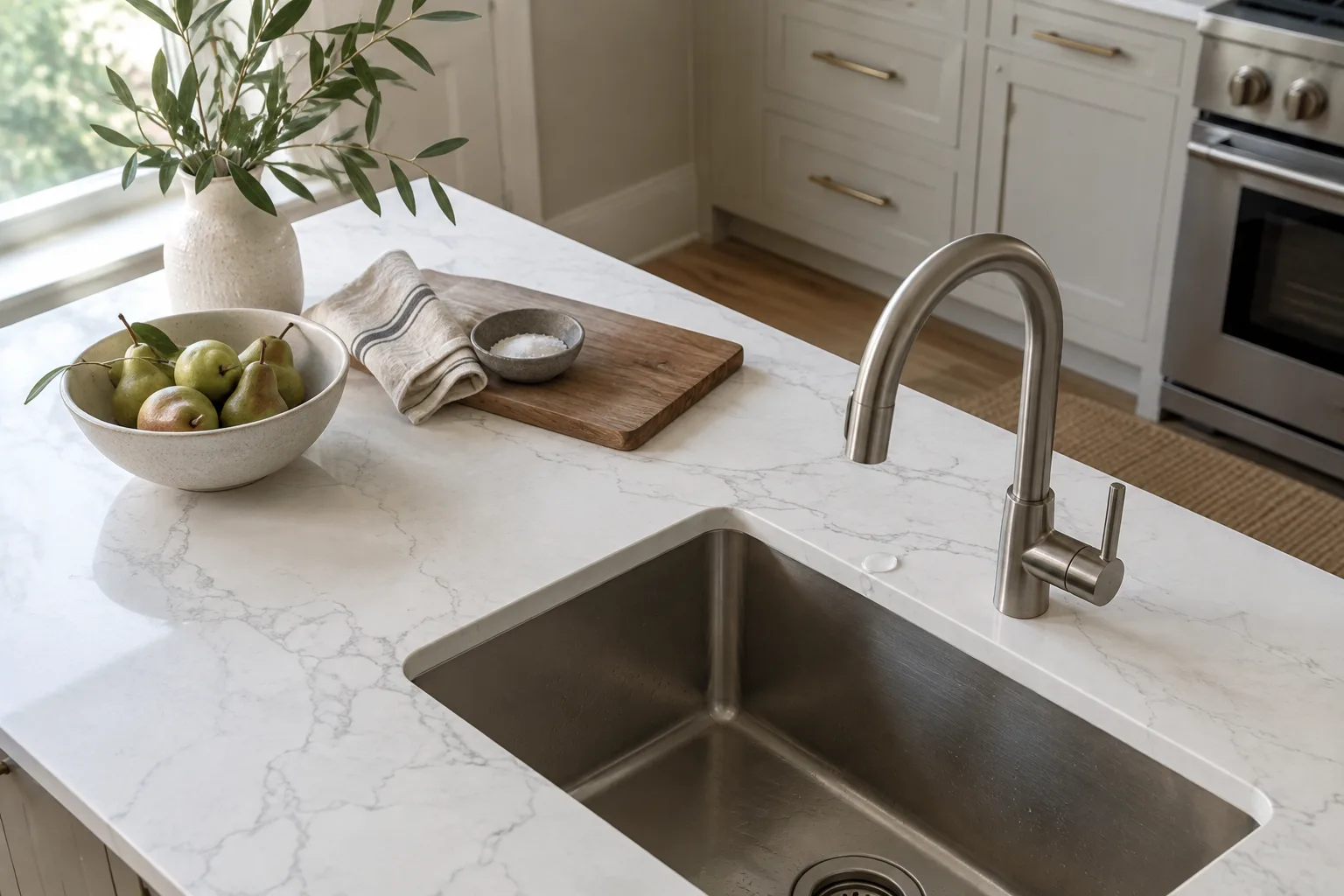
Butt joint
Two flat edges meet in a straight line. It is the most common seam along a long run and the easiest to keep thin.

Henderson Custom Countertops specializes in seamless countertop joining & seam matching in Hendersonville, NC so a long run reads as one piece of stone. We choose where each joint falls, match the pattern across it, and bond it flat with color-matched adhesive.
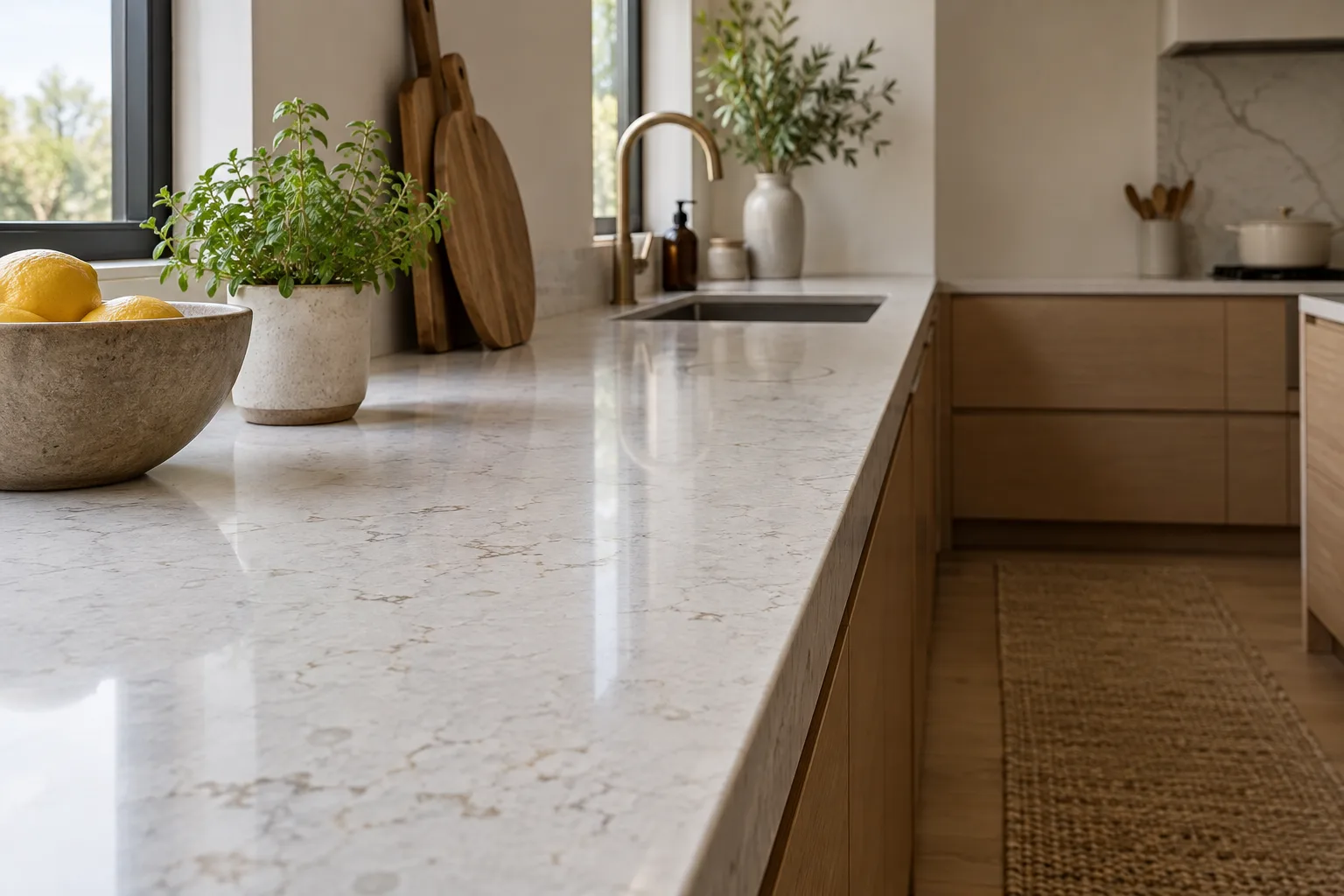
A seam is needed whenever a countertop is longer or wider than the slab it comes from, and a good one is hard to see or feel. Most slabs are not big enough for an L-shaped kitchen, so a joint is normal, and the craft lies in the placement, the pattern match and the finish of the bond line.
We lay the seams out on your slab before cutting, and we show you the drawing. Homeowners in Hendersonville, Flat Rock, Laurel Park and Mills River tend to ask the same question first: will I see it? On a well-planned job, you should have to look for it.
Why Henderson Custom Countertops
Whoever measures your cabinets is the person accountable for the finished top.
A seam belongs where it is least likely to catch the eye and least likely to carry stress. Sinks, cooktops and unsupported spans are the places we steer joints away from, because those are where stone is weakest or most often touched.
Slabs are cut from a block, and most are around 9 to 11 feet long, so a kitchen with a long wall and a return almost always needs one joint, and a bigger layout may need two. The aim is the fewest seams that keep every piece strong and every vein plausible.
Our rules of thumb:
Sometimes the best place is not the neat one on paper. If the template shows a better spot a few inches over, we move the joint there and tell you why.
Matching starts with how the slab is cut, not how it is glued. When two pieces come from the same slab in order, the pattern flows from one into the next, and when they come from different slabs or different lots, the color can shift at the line no matter how well it is finished.
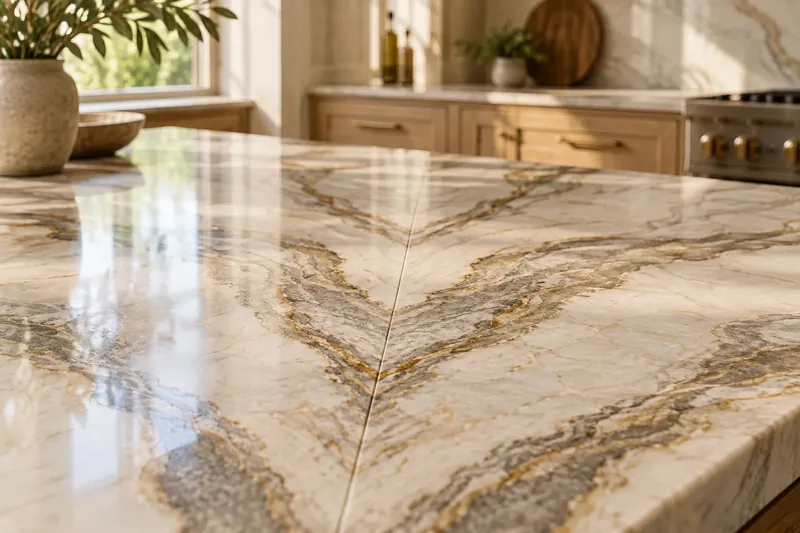
For veined stone we choose between two ways of arranging the pieces. A sequential match keeps the pieces in the order they came off the slab, so the pattern continues. A book match opens two consecutive cuts like pages, so the vein mirrors itself across the joint, which looks deliberate and is often used on a waterfall panel or a feature island.
Solid colors and fine speckled stones are much easier to match than strongly veined ones. Quartz is made to a recipe, but its pattern can still run in a direction, and the pieces have to be turned the same way, or the join reads as a stripe.
This is what we check before cutting:
We dry-fit the pieces in the shop whenever the layout allows, so you are not seeing the match for the first time on install day.
A seam usually adds a modest amount to a job, typically estimated at about $100 to $350 per joint for shop labor and finishing, with larger or mitered joints near the top of that range. The written quote after your measure shows the actual number for your layout.
The reason is simple: each seam needs edge work on both faces, careful polishing, and extra time at the install. More seams are not a saving. A cheaper layout with more joints can cost more in labor than one extra slab, and it looks worse.
Other things shape the estimate:
Treat these figures as estimates only. We would rather spend a few minutes planning at the template than promise a number we cannot hold.
A joint is made by bonding two polished edges with a color-matched adhesive, then pulling them tight so the line is as thin as it can be. On a good job it feels flat under a fingertip and shows as a hairline.
First the two edges are cleaned and checked for chips. We mix the adhesive to match the stone, using tints chosen under the light the kitchen actually has, since a shade that looks right in the van can look off at the window. The adhesive goes on, the pieces are drawn together with clamps or vacuum cups, and the tops are leveled to each other with small shims or a leveling tool.
Then the excess is cleared before it hardens, and the cured line is lightly polished flush. The sequence is:
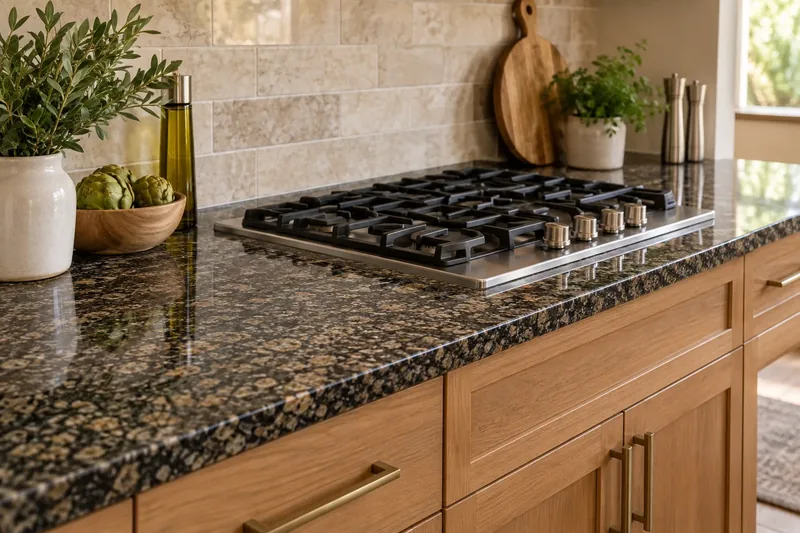
What we will not promise is an invisible seam on every stone. Dark and glossy surfaces show a joint more than light, patterned ones. We will tell you at the measure how a particular slab is likely to look, and where the line will sit, so there is no surprise.
Which joint suits your top depends on the shape of the room and the pattern of the stone.
Two flat edges meet in a straight line. It is the most common seam along a long run and the easiest to keep thin.
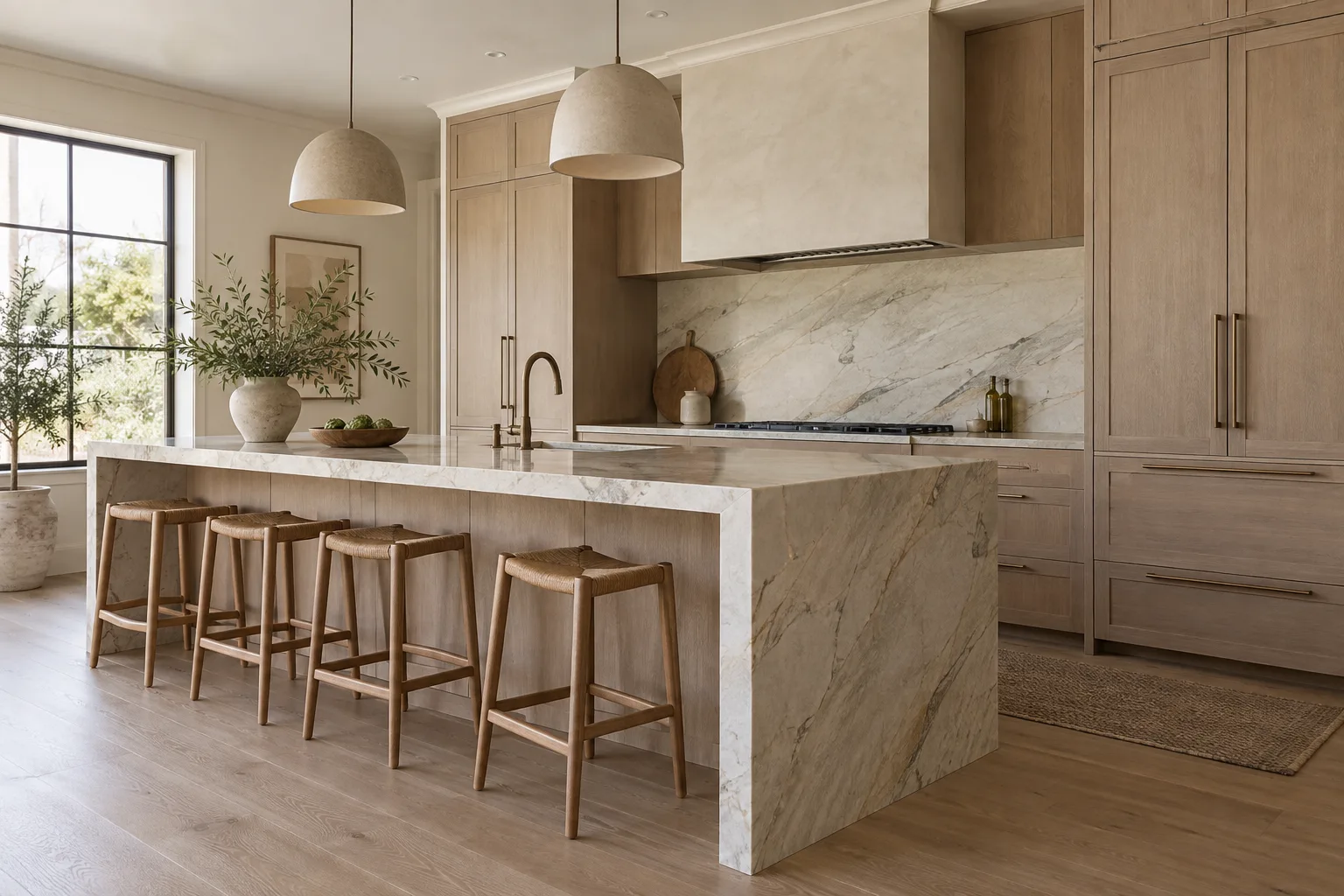
Two pieces are cut at 45 degrees and bonded to turn a corner, which keeps the vein running around the edge of an island or waterfall.
Two mirrored cuts of one slab are joined so the pattern reflects across the line. It gives a feature look but needs enough slab to match.
The two legs of an L-shaped kitchen meet at the inside corner, placed where cabinets give full support and the line stays out of view.
Start to finish
The layout is agreed with you before any stone is cut.
We measure the room and mark every possible joint, with the cabinet supports and the sink and cooktop openings in view.
We lay the pieces over a photo or drawing of your slab and show you where each joint and vein will fall.
The pieces are cut, edged and polished, then dry-fit in the shop to confirm the match.
We bond, level and polish the joints on site, then show you the finished lines in your own light.
Straight answers
Only if the whole top fits on one slab and can be carried in as one piece. A small kitchen with a straight run can, but an L-shape or a long island usually needs at least one joint, and we plan it to be as quiet as possible.
We decide that with you at the template, then show it on a drawing of your slab. We favor a spot over solid cabinet support, clear of the sink and the range, and away from where the eye lands first.
A well-made joint is level, so your hand should glide over it. We check across the line with a straightedge and a fingertip before we leave.
Yes. Dark, solid and glossy surfaces show a bond line more clearly than light, speckled or veined ones, because the adhesive color is harder to hide. We explain this before you pick a slab.
Not when it is planned right. The risk comes from a joint placed over an open span or beside a cutout, so we keep seams over supports and away from the narrow strips next to openings.
A seam typically adds an estimated $100 to $350 per joint in shop work and finishing, more for a mitered or book-matched one. The written quote sets the final price.
A regular seam just joins two pieces. A book match joins two mirrored cuts from one slab so the veining reflects across the line. It looks intentional but needs a slab that suits it.
Often. A gap or ridge can sometimes be reworked by releveling or re-bonding the pieces. If an old joint has failed because of movement in the cabinets, we find that cause first.
We measure kitchens across Henderson County and draw the layout for your approval. Send your details and we will set a visit.
Licensed, bonded & insured. Calls only, we do not receive text messages.