Cut wet on a diamond blade
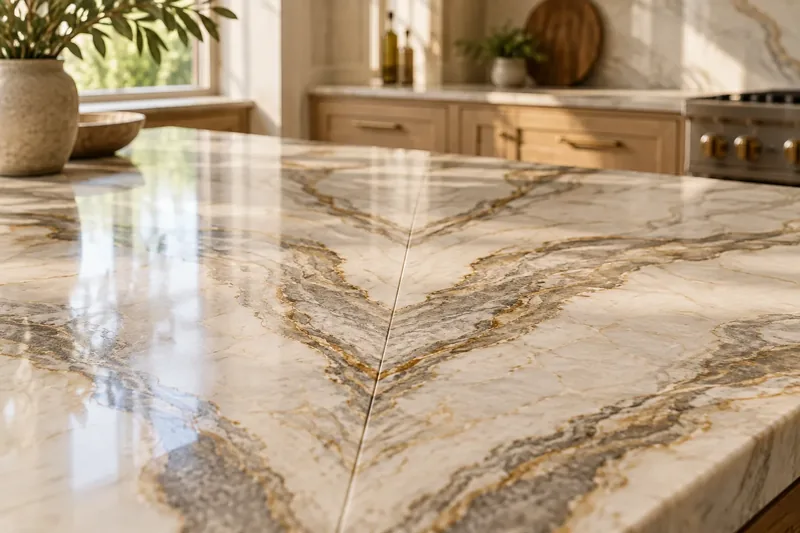
The 45-degree face is cut with a diamond blade running wet, the tool made for stone, and checked against its partner before any glue comes out.

Henderson Custom Countertops is Henderson County's leading fabricator of waterfall edge countertops in Hendersonville, NC, specializing in 45-degree mitred joints, vein-matched legs and floor-level finishing. We offer single waterfall ends on quartz countertops and double-leg islands in quartzite.
Our team provides the leg-to-top glue-up, delivering a countertop whose pattern turns the corner without a break, for both residential and commercial projects. The same crew that templates your island returns to set the mitred legs, and every cut is made wet in the shop, never inside your kitchen.
From the 45-degree mitre and the clamped epoxy joint to a leg standing plumb on your finished floor, our team handles every detail. Serving Hendersonville, Laurel Park and Etowah, we build waterfall ends that line up at the corner and sit true at the bottom.
Why Henderson Custom Countertops
Whoever measures your cabinets is the person accountable for the finished top.
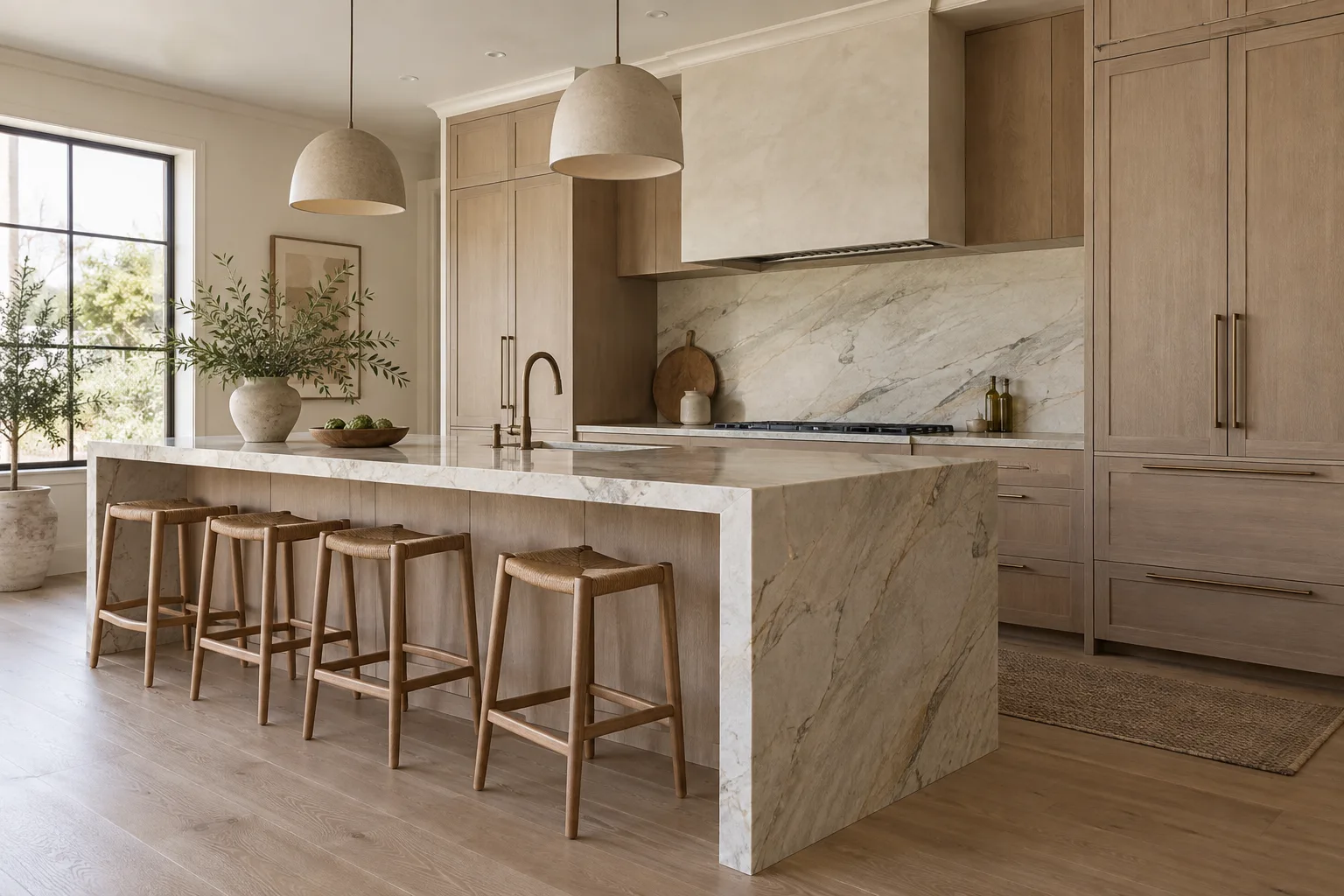
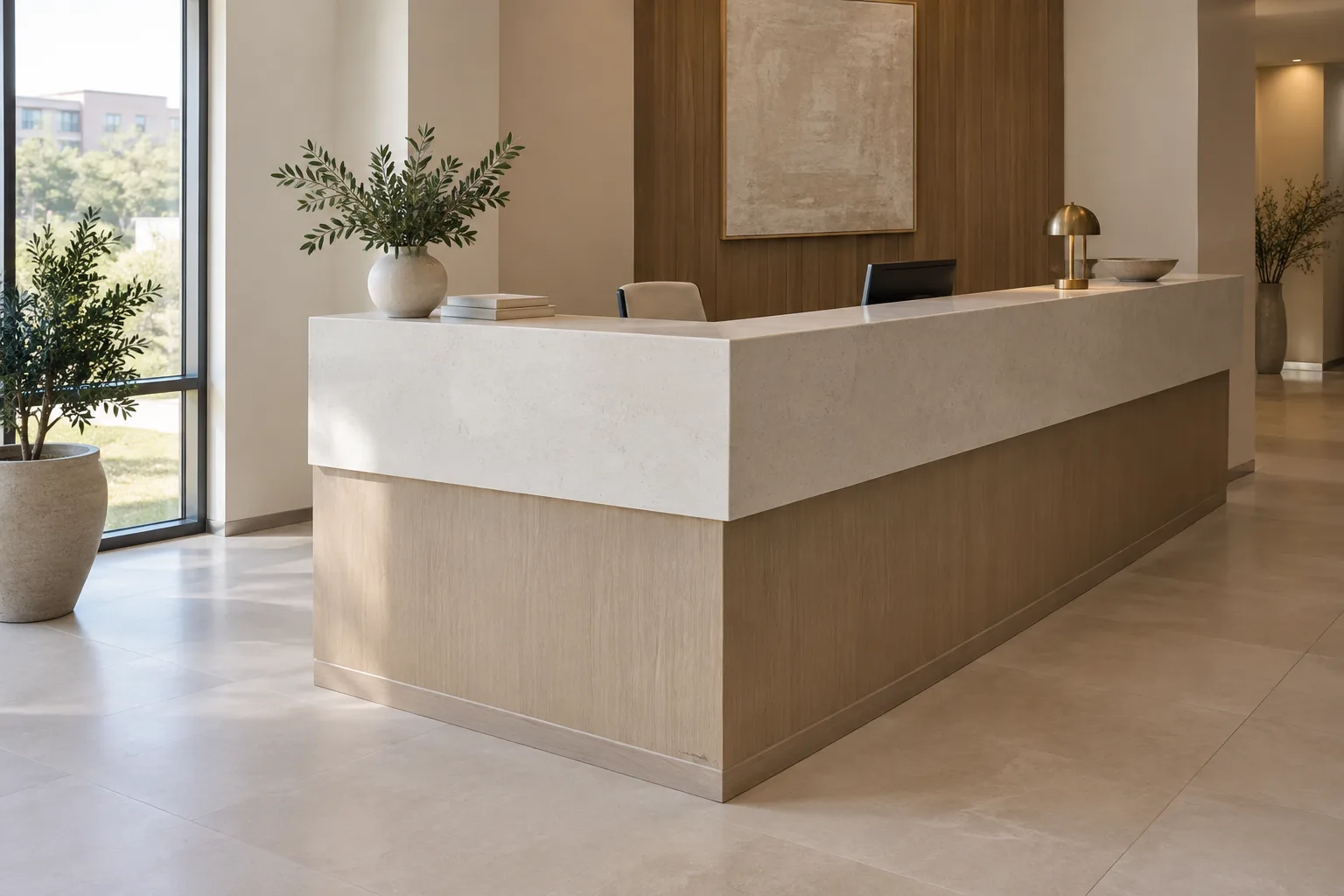
A waterfall end is a mitred joint: the top and the leg are each cut at 45 degrees so the two faces close at the corner and the pattern carries across it. Caesarstone describes the cut as a precise 45-degree angle that lets the top and side join without a visible seam where the pattern meets, and Wikipedia's miter joint entry describes the same corner, cut on both parts so they meet cleanly. Whether the joint is glued in the shop or on site depends on the island. A short island with one leg can be glued up in the shop and carried in as one L-shaped piece. A long top with two legs is usually too heavy and awkward to move assembled, so the legs travel separately, and the mitres are glued and clamped in your kitchen after the top is set.
The 45-degree face is cut with a diamond blade running wet, the tool made for stone, and checked against its partner before any glue comes out.
Epoxy is the adhesive for stone joints. It is tinted to the stone so the line at the corner nearly disappears.
The leg is held tight to the top while the adhesive sets, then the joint is cleaned and polished to match the faces around it.
The leg comes from the part of the slab lying right next to the end of the top, so the veins that leave the top's edge carry on down the leg.
One leg or two changes the slab count, and the slab count is the biggest reason a double waterfall costs more. Caesarstone points out that a waterfall needs more material because the vertical sides are covered as well as the top. Each leg adds a panel as deep as the island and as tall as the counter, and on a long island two legs plus the top can outgrow one slab.
A single waterfall usually goes on the end people see first, from the living room or the entry. The other end finishes against a cabinet end panel. It uses less stone and often keeps the whole island on one slab.
A waterfall on both ends frames the island as a single block of stone. Caesarstone suggests it for a long rectangular island. On quartzite, the second leg may need a second slab, and then there is a second pattern to line up with the first.
Where an island becomes a peninsula, the waterfall goes on the open end and the stone stops at the wall on the other. We lay both options out on the real slab at the measure, so you see whether the second leg costs a slab before you decide.
A waterfall end is typically estimated to add roughly $1,500 to $5,000 per mitred end on top of the island price, with the stone and whether it forces an extra slab moving it most. That range comes from our trade ticket bank, and Caesarstone notes the same logic: the added square footage is charged at the normal material and installation rate, and the mitre fabrication is extra work on top.
Please read these numbers as estimates that are subject to change; the written quote after we measure the island sets the final price, and it depends on the stone, the number of legs and whether a second slab is needed.
The floor end is where a waterfall takes knocks, so it is protected on purpose. The bottom corner of a leg sits right where mops, vacuum heads and chair legs hit, and a sharp stone corner at floor level chips. We ease that bottom corner slightly and plan the leg to rest on the finished floor rather than hang just above it. Caesarstone adds a benefit that works the other way: the vertical stone panels protect the cabinet ends behind them from scratches and wear. The leg has to be plumb even when the floor is not. Many in-town Hendersonville houses date from the early 1900s to the 1940s, and a waterfall shows every bit of slope in an old floor: the leg either gaps at the bottom or tips at the top, and the mitre opens. We level the island cabinets first, then scribe the leg to the floor so the corner stays closed.
Hardwood or tile should be down before we template, so the leg is cut to the surface it will stand on.
Where the cabinet toe kick meets the leg, the cabinet maker returns the kick or finishes the end, so no raw box shows behind the stone.
Tell us where the floor changes material or height near the island; the leg is scribed to what is actually there.
Quartz is the easiest stone to waterfall, because it is made to a consistent color and pattern, and Caesarstone's advice is to pick a boldly veined surface and have the slab cut so the pattern on the top aligns with the side. Quartzite, a hard metamorphic rock that began as quartz sandstone, makes a striking waterfall, but every slab veins differently, so the layout is drawn on the actual slab rather than from a sample. Marble works, with its known trade-off: acids etch its calcite. On a vertical leg that matters less than on the top, since spills do not sit on a vertical face. Soapstone is a talc-rich stone, and talc is the softest mineral on the Mohs scale, so a soapstone leg can be mitred but its corners will mark where the vacuum hits. Granite with a strong movement reads well on a waterfall; a granite with a busy, even speckle hides the joint but shows off the effect less.
Quartz with a directional vein, laid out top to leg.
Quartzite or marble, with the leg picked from the slab by eye.
Soapstone at floor level in a busy household.
A waterfall leg is often the finishing move in the county's bigger kitchen projects. Estate kitchens in Flat Rock can carry a double-leg island. On Laurel Park's mountainside lots, bringing the legs separately and gluing on site makes a long waterfall possible up roads where an assembled piece would never turn. New custom homes in Mills River let us template the legs to a floor laid with the island in mind, and remodels in Etowah's golf communities often add a single waterfall end when an old island top is replaced.
Call to book a free measure. We will look at the floor, the island and the slab you like, and show you where one leg or two would land.
Start to finish
Nothing is cut until you have approved the slab and the seam layout.
We measure the cabinets, check them for level, look at the carry path in, and talk through material, edge and sink.
You choose the slab, and we show you where the seams and the veining will fall before anything is cut.
The stone is cut wet, edged and polished in the shop, with openings cut to the sink and cooktop you picked.
We carry it in, set it, seal natural stone that needs it, and walk the finished counters with you.
Straight answers
You will see a fine joint up close. The mitre is cut at 45 degrees and glued with epoxy tinted to the stone, and the leg is cut from the stone next to the top so the pattern crosses the corner.
Sometimes. One leg on a modest island usually fits the same slab as the top. Two legs on a long island often need a second slab, which we check on the actual stone before you commit.
Each mitred end is typically estimated to add roughly $1,500 to $5,000, driven by the extra stone and the mitre work. The written quote we send after the measure is the figure that counts.
Rarely well. New stone seldom matches an installed slab, especially natural stone, so a waterfall is usually cut together with a new top. We will tell you honestly at the measure.
A sharp corner at floor level is the part most at risk, so we ease it slightly and set the leg on the finished floor. Keeping the metal edge of a vacuum head off it does the rest.
The end you see first from the entry or living area. If both ends are on show and the budget allows a possible second slab, two legs frame the island best.
Yes. We level the cabinets and scribe each leg to the floor, so the leg stands plumb and the mitre stays closed even where the floor slopes.
Yes, along with Hendersonville, Flat Rock, Mills River and Fletcher. On steep lots we can carry the legs separately and glue the mitres in place.
We measure homes and businesses across Henderson County. Builders and businesses can send drawings for a bid.
Licensed, bonded & insured. Calls only, we do not receive text messages.