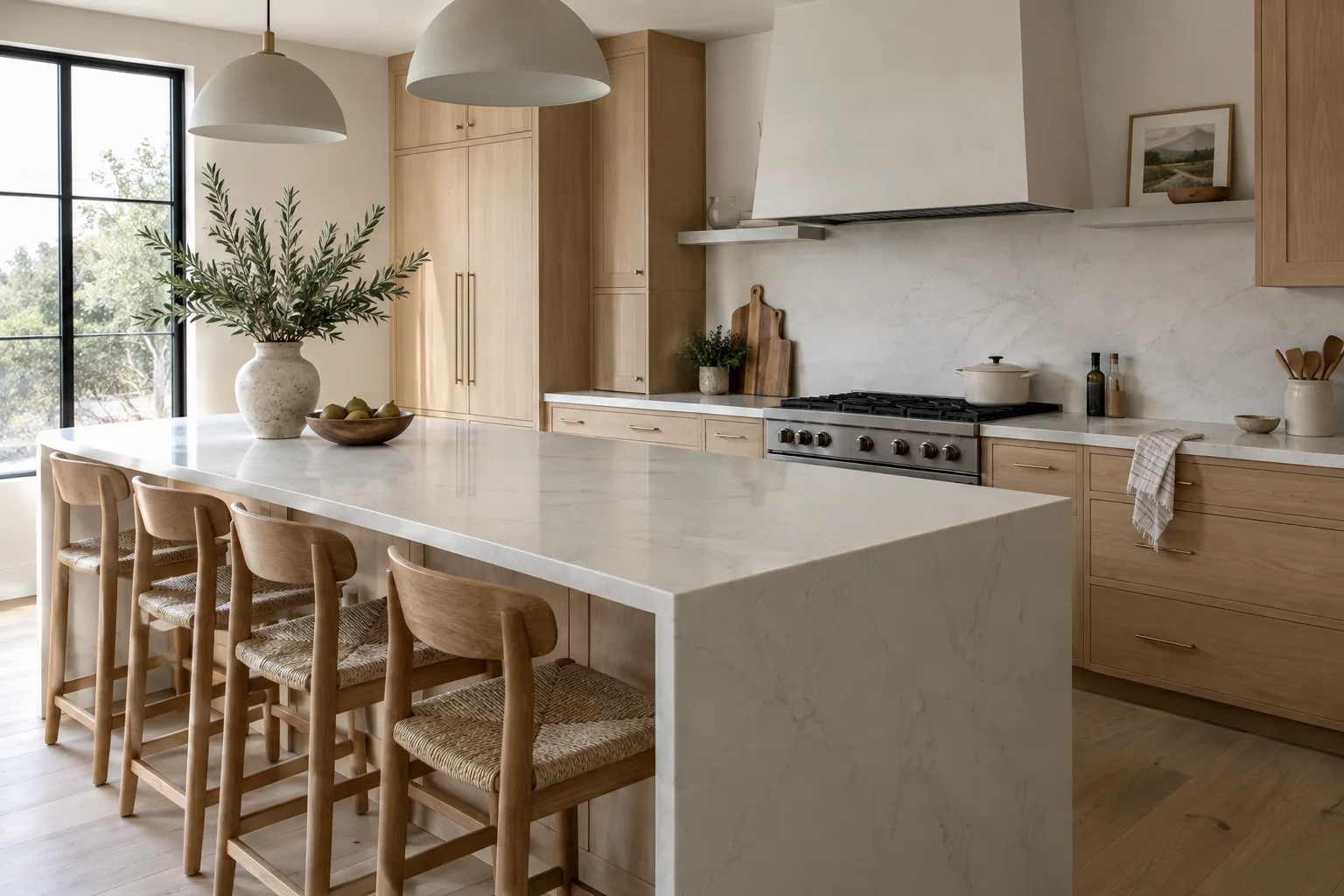
Bullnose
A broad, rounded edge that is kind to hips and elbows, a good choice on an island where people lean and children run past.

Henderson Custom Countertops fabricates granite countertops in Hendersonville, NC, as Henderson County's leading natural stone installer, specializing in full kitchens, bar-height peninsulas and double vanities cut from the slab you choose. We offer bullnose and ogee edge profiles and undermount sink cutouts.
Our team provides slab selection help at the supplier's yard, delivering a countertop that matches the stone you walked around and touched, for both residential and commercial projects. We lay out the seams on your tagged slab and wait for your sign-off before the first cut, so the pattern falls where you expected it.
From a polished ogee along the island to the penetrating sealer on the final seam, our team handles every detail. Serving Hendersonville, Flat Rock, Laurel Park and Mills River, we treat your slab as the single piece of stone it is.
Why Henderson Custom Countertops
Whoever measures your cabinets is the person accountable for the finished top.
North Carolina made granite its official state rock in 1979, and the choice was earned. When it was named, the Mount Airy quarry in Surry County was the largest open-face granite quarry in the world, measuring about a mile long and 1,800 feet wide.
That quarry was opened in 1889, and its stone went into the Wright Brothers National Memorial at Kitty Hawk, the Arlington Memorial Bridge and the United States Bullion Depository at Fort Knox. North Carolina also holds the second largest quantity of granite in the Southeast, behind only Georgia. Closer to home, the village of Flat Rock takes its name from the granite formations that dotted its ground.
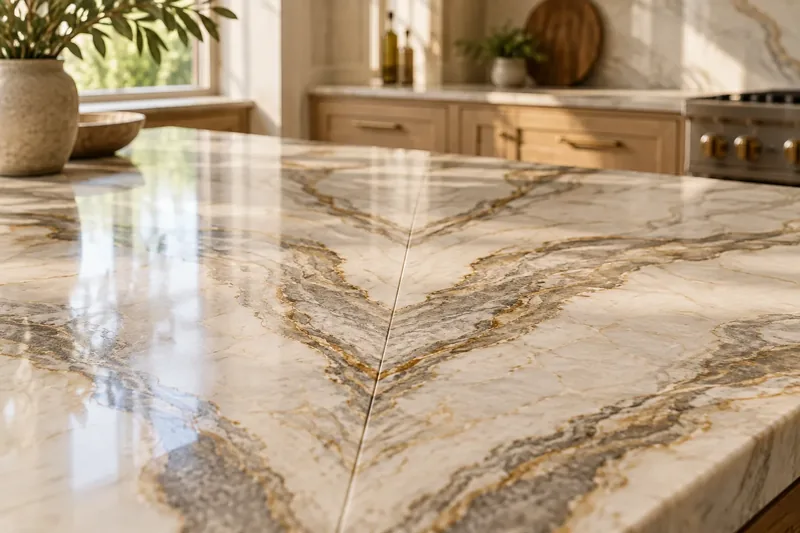
A kitchen slab on a supplier's rack may have been quarried in this state or shipped from much farther away. For your kitchen, the origin matters less than the slab itself: its color, its movement, its natural pits and fissures, and how it reads under your own light. That is why we send you to see the actual slab rather than choose from a chip.
Choose granite by standing in front of the full slab, because no two are alike and a small sample cannot show you a sweep of veining, a cluster of mica or a natural fissure. Bring a cabinet door and a floor sample if you can.
Suppliers sort granite into price levels or groups, usually numbered from an entry level up to exotic. There is no single industry standard for those grades; each supplier runs its own system, and the level reflects rarity, color and pattern rather than how tough the stone is. An entry-level slab is not a weaker slab.
It also helps to know that granite is a loose word in the stone trade. Commercial granite often includes other intrusive rocks such as gabbro and diorite, sold under the same name. True granite is a coarse-grained rock of quartz, alkali feldspar, plagioclase and mica: the feldspar carries much of the color, and the mica gives the flecks of shimmer you see when you tilt your head.
At the yard, look for these four things:
Once you choose, the slab is tagged for your job, and that tagged stone is the one we template and cut for.
Granite countertops in Henderson County are typically estimated at roughly $40 to $100 per square foot installed, with the price level of the slab, the edge profile and the number of cutouts moving the figure most. An entry-level slab with a plain edge sits near the low end, and a rare, heavily veined stone finished with an ogee sits near the top.
A kitchen with around 40 square feet of counter would therefore typically fall somewhere near $1,600 to $4,000 in granite, before tear-out and extras.
Every figure above is an estimate and can change with slab availability and whatever the measure uncovers; the written quote after your free measure visit sets the final price.
Some granites need sealing and some barely do, and a simple water test tells you which one you own. Pour a puddle about 3 inches across on a few spots and watch it: if the stone darkens in under 30 minutes it is absorbing and should be sealed, and if it holds its color past 30 minutes the protection is doing its job.
The reason is in the rock. Granite has low permeability through its grains but can draw water in through tiny cracks and fissures, and some slabs are simply more porous than others, so two granites in the same kitchen can behave differently.
We run the water test at install and seal where the stone asks for it, using a penetrating sealer that soaks into the pores without changing the finish. Then we show you how to repeat the test yourself, so you reseal when the stone tells you to rather than on a calendar.
Granite is also naturally resistant to acid. A squeeze of lemon or a splash of vinegar that would etch the calcite in marble leaves a sealed granite top alone, which is a large part of why it earned its place in American kitchens.
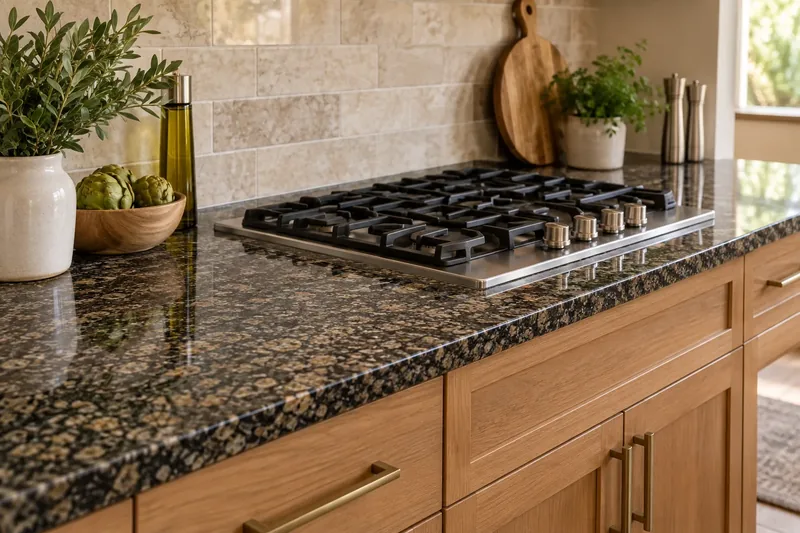
Granite takes a shaped edge well because it is massive and tough, with a compressive strength that usually runs above 200 MPa, so a profile cut on a router holds its line. The edge you pick should suit the house as much as the slab.
A broad, rounded edge that is kind to hips and elbows, a good choice on an island where people lean and children run past.
An S-shaped profile, a concave curve flowing into a convex one, that suits traditional cabinetry and the older houses around downtown Hendersonville and Flat Rock.
Two pieces meet at 45 degrees so the front reads as a thick block of stone, a way to get a heavy, modern look without buying a thicker slab.
A clean, flat edge with the arris lightly softened, the plainest look and usually the least shop time. Weight is part of the edge conversation too. Granite averages about 2.65 to 2.75 grams per cubic centimetre, so we check cabinet level and the support under any overhang before a heavy apron or a deep peninsula goes down.
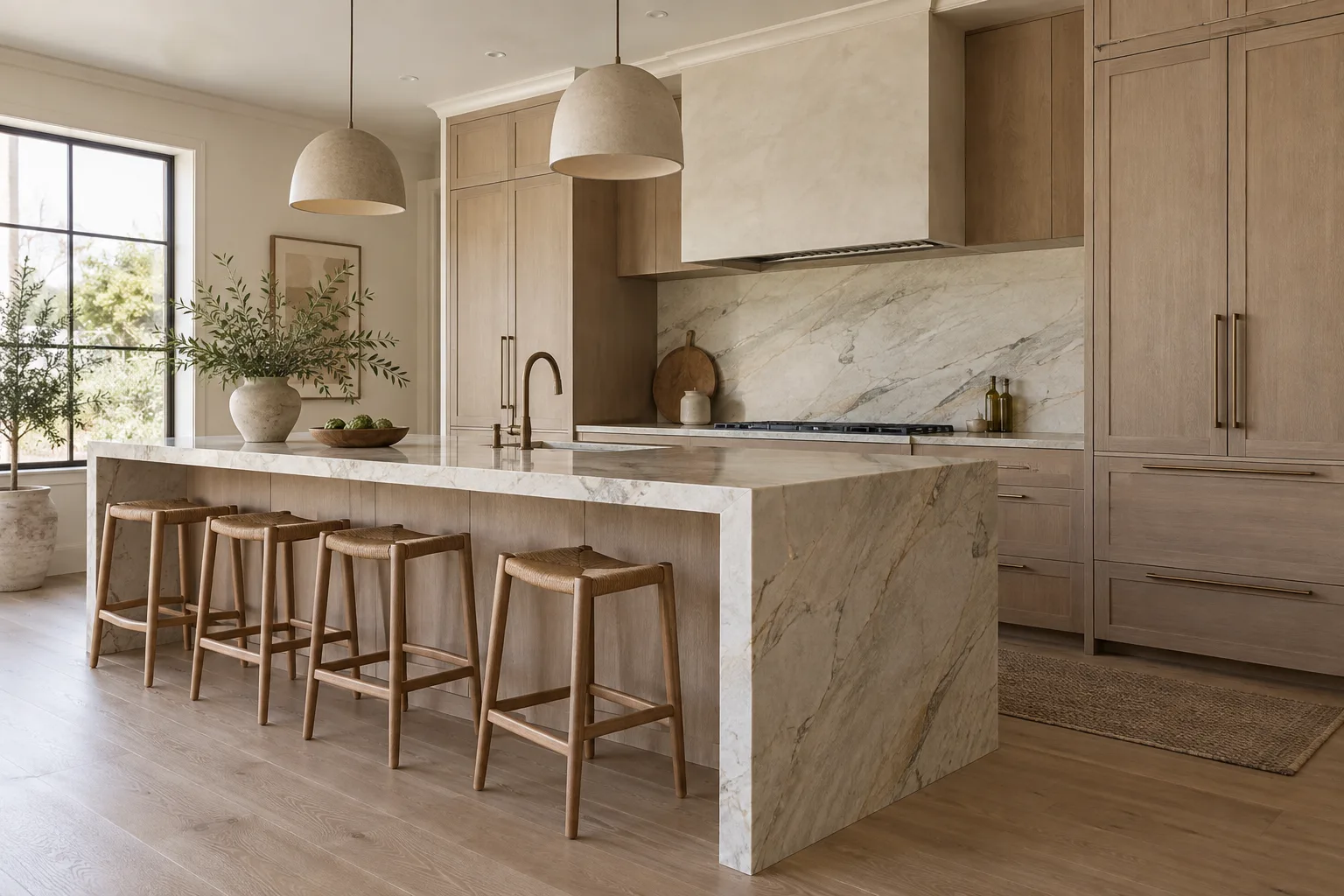
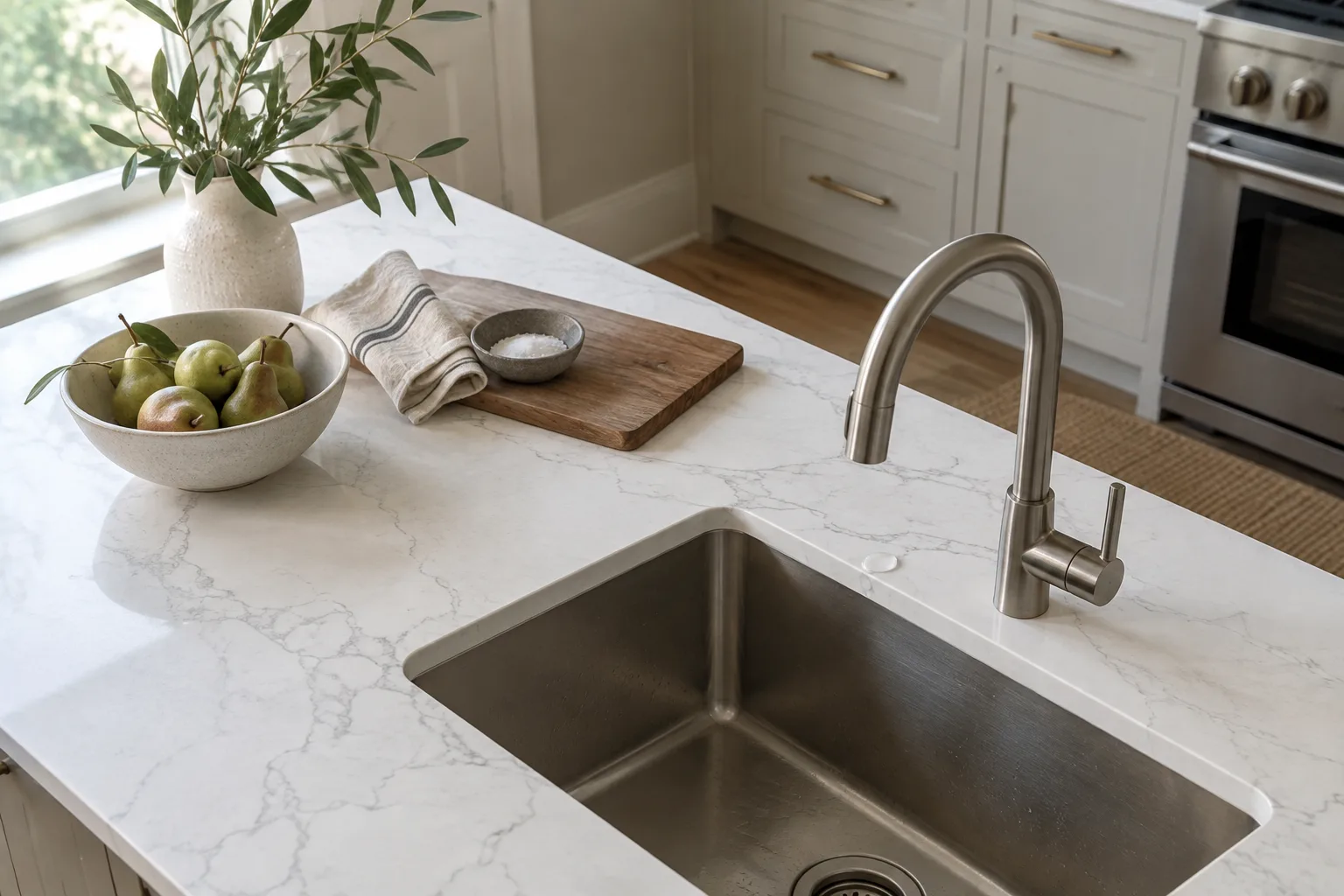
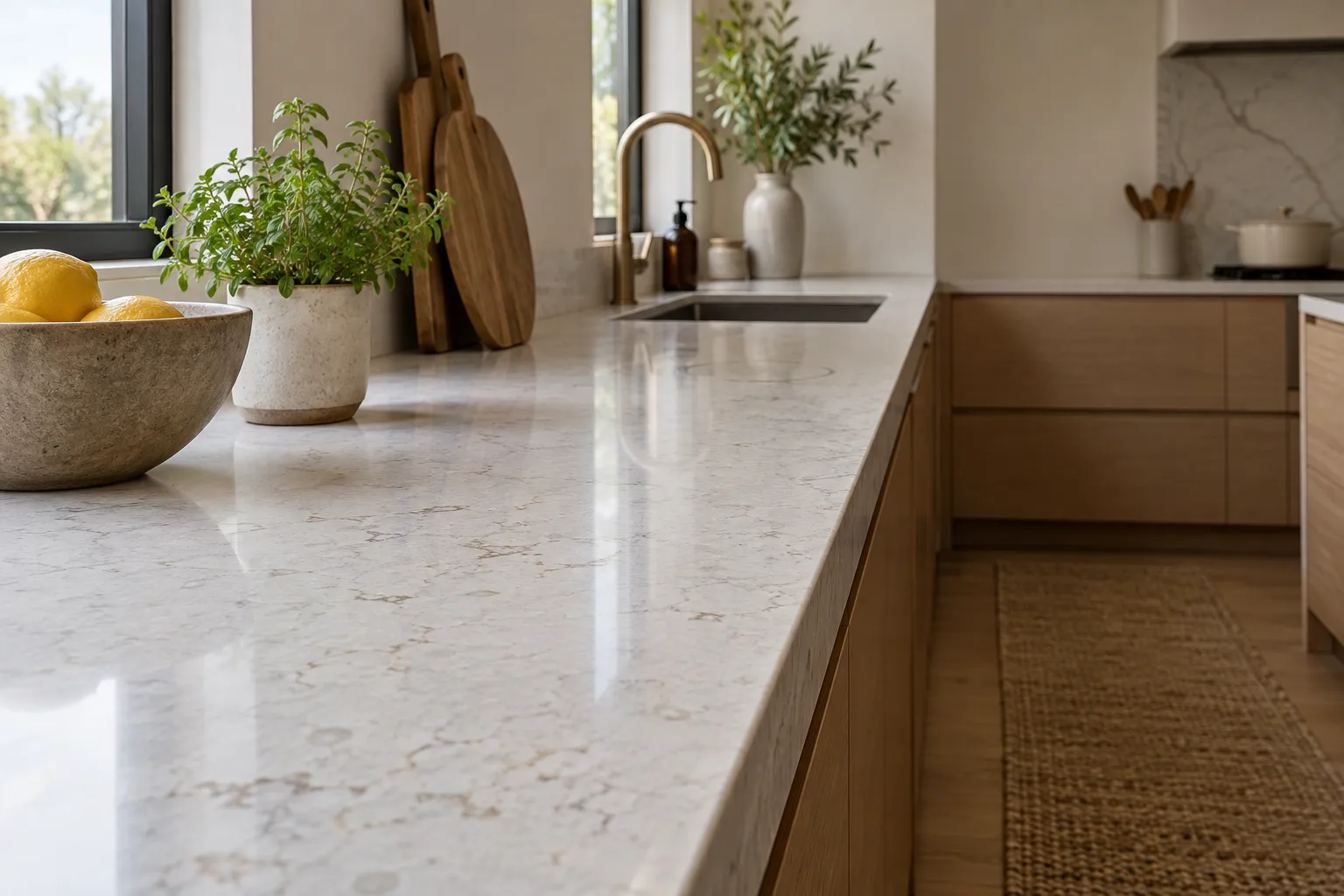
Start to finish
Nothing is cut until you have approved the slab and the seam layout.
We measure the cabinets, check them for level, look at the carry path in, and talk through material, edge and sink.
You choose the slab, and we show you where the seams and the veining will fall before anything is cut.
The stone is cut wet, edged and polished in the shop, with openings cut to the sink and cooktop you picked.
We carry it in, set it, seal natural stone that needs it, and walk the finished counters with you.
Straight answers
Some do and some barely do. Pour a puddle of water about 3 inches wide on the stone; if it darkens within 30 minutes, the granite is absorbing and should be sealed. We test and seal at install.
When it fails the water test, not on a fixed schedule. Denser slabs can go a long time between sealings, while more porous ones need it more often.
Yes, and we recommend it. You pick the slab at a stone supplier's yard, it is tagged for your job, and we lay out the seams on that exact slab for your approval before cutting.
It is the supplier's price tier, based on rarity, color and pattern. There is no single industry standard, and a higher level is not a harder or longer lasting stone.
Granite is typically estimated at roughly $40 to $100 per square foot installed, depending on the slab level, edge and cutouts. After the free measure, your written quote sets the final price.
Not always. The stone trade sells other intrusive rocks such as gabbro and diorite as granite. They perform much like granite in a kitchen, but the name on the tag is a trade name, not a geology lesson.
Almost any. Bullnose suits family kitchens, ogee suits traditional cabinets, and a mitered apron gives a thick modern look. We will show you samples of each at the measure.
Yes. We tear out and haul away the old top and level the cabinets. A licensed plumber handles disconnecting and reconnecting the sink, since plumbing is its own licensed trade in North Carolina.
We measure homes and businesses across Henderson County. Builders and businesses can send drawings for a bid.
Licensed, bonded & insured. Calls only, we do not receive text messages.