The bar top
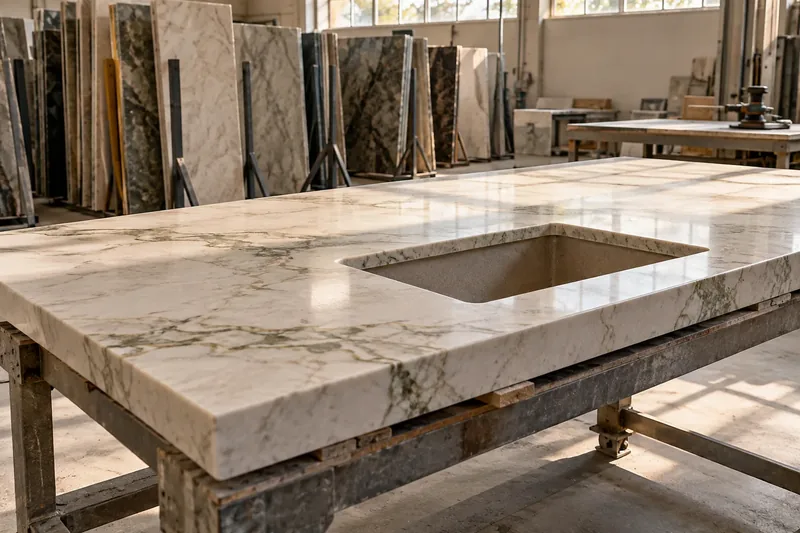
The longest single run in most rooms, usually with a drink rail side, a service side and one or more sink and ice bin cutouts under it.

Henderson Custom Countertops is the Henderson County specialist for restaurant and brewery countertops in Hendersonville, NC, specializing in taproom bar tops, pickup counters and pass-through shelves. We offer honed granite and dense quartzite for front-of-house counters that take a beating every night.
Our team provides templating around coolers, glass rinsers and stainless prep tables, delivering tight, sealed joints an inspector can run a finger along, for both residential and commercial projects. Before a single slab goes on the saw, we return shop drawings and submittals to the owner or general contractor for sign-off, and our own crew measures the finished bar die wall rather than trusting the plan dimensions. Licensed, bonded and insured, we bid as the countertop subcontractor under your GC or straight to the owner on a tenant fit-out.
From sink cutouts sized to the bar equipment schedule to the final bead of sealant where stone meets stainless, our team handles every detail. Serving Hendersonville, Mills River, Fletcher and Etowah, we put the install on the days your doors are closed or ahead of the opening date agreed with the builder.
Why Henderson Custom Countertops
Whoever measures your cabinets is the person accountable for the finished top.
A restaurant or taproom package in Henderson County is every stone surface the public touches plus the ones staff lean on: the bar, the back bar, the pickup counter, the host stand and the restroom vanities. We price and build them as one scope so the stone matches from the front door to the tap wall. The stainless on the cook line belongs to the kitchen equipment supplier, and we fit our tops to it rather than replace it.
The longest single run in most rooms, usually with a drink rail side, a service side and one or more sink and ice bin cutouts under it.
A lower, narrower counter along the tap wall or bottle display, often broken up by coolers and a beer tower drain.
The counter where a server or guest collects food, sized to the point of sale hardware and the tray traffic.
The shelf between the kitchen and the dining room where plates wait for a runner, which sits right beside heat lamps and stainless.
Guest restrooms, which take hand soap, paper towel water and heavy daily cleaning.
The best stone for a Hendersonville bar top is a hard natural stone such as granite or quartzite, because a bar takes spilled drinks, dropped glassware and elbows for hours at a stretch. Granite is a coarse grained igneous rock of quartz, feldspar and mica, and quartzite began as quartz sandstone before metamorphism made it hard. Both hold up to glass bottoms sliding across them far better than a soft stone.
Marble is the stone we talk owners out of for a cocktail bar. It is calcite, the stable form of calcium carbonate, and calcite dissolves in acid, which is why lemon and lime juice dull a polished marble top. A bartender cutting citrus all night will etch it. If marble is the look you want, we steer it to a host stand or a wall piece away from the pour station.
Engineered quartz is roughly 93 percent crushed stone held in about 7 percent polyester resin by weight. It is non porous, which a bar owner likes, but the resin makes it less heat resistant than granite, and direct heat can damage it. We keep it off the pass shelf under heat lamps and away from anything that will set a hot pan down.
Soapstone is a talc schist, heat resistant and dense. Talc sits at 1 on the Mohs scale, so soapstone scratches and scuffs, but the marks sand back out. It suits a rustic taproom back bar where a worn surface fits the room.
The 2010 ADA Standards set the rules for the counters the public uses. Where a restaurant or bar provides dining surfaces for food or drink, at least 5 percent of the seating and standing spaces at them must comply with section 902, which puts the top between 28 and 34 inches above the floor. A sales or service counter needs an accessible portion no higher than 36 inches, at least 36 inches long for a side approach or 30 inches long with knee space for a front approach. Your architect draws those heights; we build the lowered section in the same stone so it reads as part of the bar and not an afterthought.
Near food prep in North Carolina, the surfaces are judged against the FDA Food Code, which the state adopted by reference in its food establishment rules, 15A NCAC 18A .2600. The 2017 Food Code and its Supplement took effect here on October 1, 2021, according to the NC Food Code Manual published by NC DHHS. That is the document the county inspector works from, so it is the document we build to.
That is why the prep line in almost every commercial kitchen is stainless steel, an iron and chromium alloy that resists rust and corrosion. North Carolina's rule adds that food equipment should be certified for sanitation by an ANSI accredited program, or else meet Parts 4-1 and 4-2 of the Food Code. We do not claim any certification for a stone slab. What we do is keep stone on the bar, the pickup counter and the service side, and meet the stainless cleanly where the two touch: a tight joint, sealed with a food-area sealant, with no open seam for residue to sit in.
Under the North Carolina amendment to Food Code section 8-201.11, plans drawn to scale for an independent restaurant go to the local health department for review and approval, and a chain or franchise sends them to the state Environmental Health Services Branch. That review applies before construction, before an existing building is converted, and before a remodel when the regulator asks for plans. We price from the plans that went in for review, so what we build is what the inspector already saw.
A restaurant, bar or brewery countertop package is typically estimated at roughly $10,000 to $60,000, based on the commercial ticket ranges in our trade research, and where a job lands inside that band depends on length of bar, stone grade and how many trips the schedule needs. That range is a budgetary estimate for framing a project, not a quote.
Every figure on this page is an estimate and is subject to change with stone prices and the drawings; the written bid sets the final price. Send the drawings, the finish schedule and the bar equipment list, and we will return a line-item bid.
Countertops go in near the end of a restaurant build, after the bar die wall, the base cabinets and the stainless are set, and before the final health inspection. That order matters. We template on the installed bar and equipment, not from the drawings, so the cutouts land where the ice bin and rinser actually sit.
On a remodel of a restaurant that is trading, the question is always which day the doors can stay shut. We plan the tear-out and the new tops for the same closed day where the bar length allows it, and we tell you at bid time if a long bar needs two.
Many Hendersonville taprooms and dining rooms sit inside historic masonry. Downtown is the Main Street Historic District, with 65 contributing buildings on 34 acres dating from about 1850 through the 1939 J.C. Penney Building. The Seventh Avenue Depot District holds 27 contributing buildings, including the 1902 to 1904 Southern Railway depot, stores and warehouses that make natural brewery and restaurant shells.
An old storefront rarely has a square wall or a level floor, and a long bar exposes both. That is the practical reason we template in the room: a bar top cut to plan dimensions in a century old building can leave a gap at the wall that no bead of caulk should have to fill. We scribe the stone to the wall instead, and plan seams so they fall over a support rather than in the middle of the pour station.
Out toward Mills River, the brewery corridor grew after Sierra Nevada opened its second brewery there, with a restaurant, in 2014. Fletcher, beside Asheville Regional Airport and I-26, adds newer commercial shells where the walls are straighter and the schedule is tighter.
Start to finish
Nothing is cut until you have approved the slab and the seam layout.
We measure the cabinets, check them for level, look at the carry path in, and talk through material, edge and sink.
You choose the slab, and we show you where the seams and the veining will fall before anything is cut.
The stone is cut wet, edged and polished in the shop, with openings cut to the sink and cooktop you picked.
We carry it in, set it, seal natural stone that needs it, and walk the finished counters with you.
Also from our shop
Straight answers
Yes. We bid from the architectural drawings, the finish schedule and the bar equipment list, then confirm every dimension with a site template before fabrication. Plans that went to the health department for review are the ones to send.
A hard natural stone such as granite or quartzite is the usual choice for a working bar, because it shrugs off glassware and spills. Marble etches under citrus, and engineered quartz does not like direct heat, so we place those two elsewhere in the room.
The prep line is normally stainless, supplied with the kitchen equipment, because the Food Code asks for smooth, nonabsorbent, corrosion resistant surfaces there. We run stone on the bar and service side and seal the joint where it meets the stainless. Your health department plan review has the final say.
Yes. Installs can be set for the days you are closed or for an overnight window, and after-hours work is priced as its own line so you see what it adds.
A licensed plumber. Plumbing is its own licensed trade in North Carolina, so we cut the openings and set the sinks we are given, and the plumber reconnects the water and drains.
At bid, so the stone, the edge details and the submittals are settled before the bar framing is built. The template itself waits until the bar die wall and equipment are in place.
Yes. A certificate of insurance and a W-9 go out with the bid package on commercial work, and additional insured wording is handled at award.
We measure homes and businesses across Henderson County. Builders and businesses can send drawings for a bid.
Licensed, bonded & insured. Calls only, we do not receive text messages.