Beside the cooktop
Keep a trivet on the counter and use it every time. If nobody in the house will, porcelain or granite is the kinder material for that stretch of counter.

Henderson Custom Countertops installs quartz countertops in Hendersonville, NC, and is Henderson County's trusted engineered stone specialist, specializing in kitchen perimeter runs, island tops and bathroom vanity tops. We offer undermount sink cutouts and matching quartz splash pieces.
Our team provides on-site templating and full slab fabrication, delivering a countertop with even color from one end of the room to the other for both residential and commercial projects. Every cut is made wet in our own shop rather than dry in your kitchen, so the silica dust stays in the water and out of your house, and each seam position is marked on the slab for your approval first.
From seam placement across a veined pattern to the last bead of silicone where the top meets the wall, our team handles every detail. Serving Hendersonville, Fletcher, Mills River and Etowah, we bring the same careful wet cut and the same tidy install to each quartz kitchen.
Why Henderson Custom Countertops
Whoever measures your cabinets is the person accountable for the finished top.
Engineered quartz is crushed natural quartz, roughly 90 to 93 percent of the slab by weight, held together by about 7 to 10 percent polyester resin and pressed into a slab. That resin is the whole story of this material in a Henderson County kitchen: it is why quartz never needs a sealer, and it is also why quartz has limits a natural stone does not.
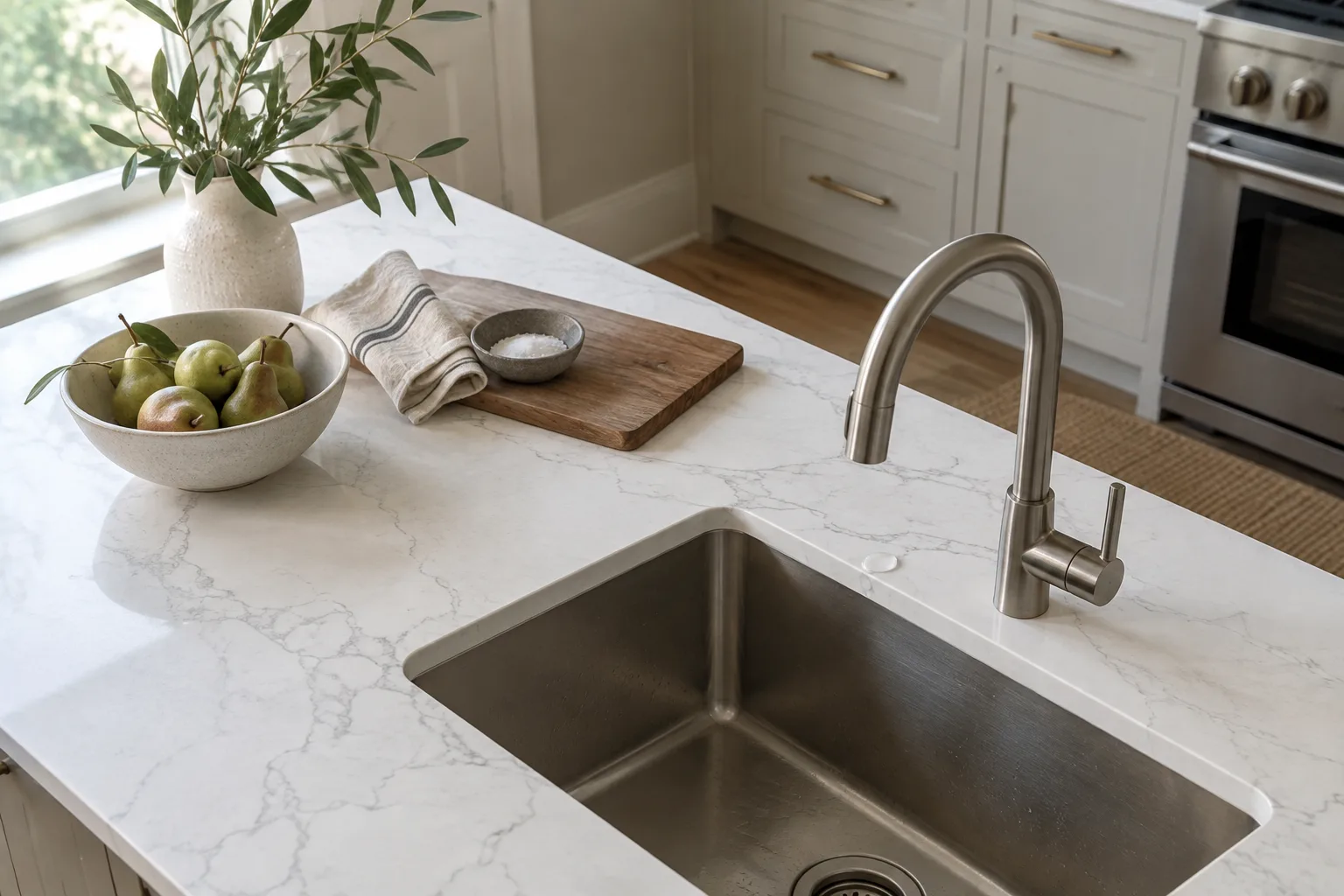
The mineral itself is hard. Quartz is the mineral that defines 7 on the Mohs scale, so the stone grains themselves stand up well to the scuffs of daily cooking. Because the slab is non-porous, coffee, red wine and cooking oil sit on the surface instead of soaking in, and there is no sealing appointment to keep the way there is with granite or marble.
Daily care is plain. Caesarstone, a quartz maker, tells owners to wipe the top with a damp cloth and warm soapy water or a mild detergent, rinse, and dry it. The same guidance says to keep oven and grill cleaners, toilet bowl cleaners, dishwasher polishing agents and paint strippers off the surface, and to skip abrasive scrub pads. Those products attack the resin, not the stone.
A note on the name. The quartz in a kitchen slab is not the ultra-pure quartz the Spruce Pine mining district in the North Carolina mountains is known for. Spruce Pine supplies an estimated 70 to 90 percent of the world's high-purity quartz, which goes into the crucibles that grow silicon for chips and solar panels, a different product entirely from the crushed quartz in your counter.
Quartz is the wrong pick beside a range where hot pans land straight off the burner, under a window that bakes in afternoon sun, and anywhere outdoors. All three come back to the resin. Engineered quartz is not affected by temperatures below about 150 degrees Celsius, or 300 degrees Fahrenheit, but a skillet off a gas burner or a sheet pan from the oven runs hotter than that. Caesarstone's care guidance says not to set pots, pans or oven trays above 300 degrees Fahrenheit directly on the surface, to use a hot pad or trivet instead, and warns that sudden, rapid temperature changes can damage the top. Overheated resin can discolor, cloud or spot, and that kind of mark is in the surface, not on it.
Keep a trivet on the counter and use it every time. If nobody in the house will, porcelain or granite is the kinder material for that stretch of counter.
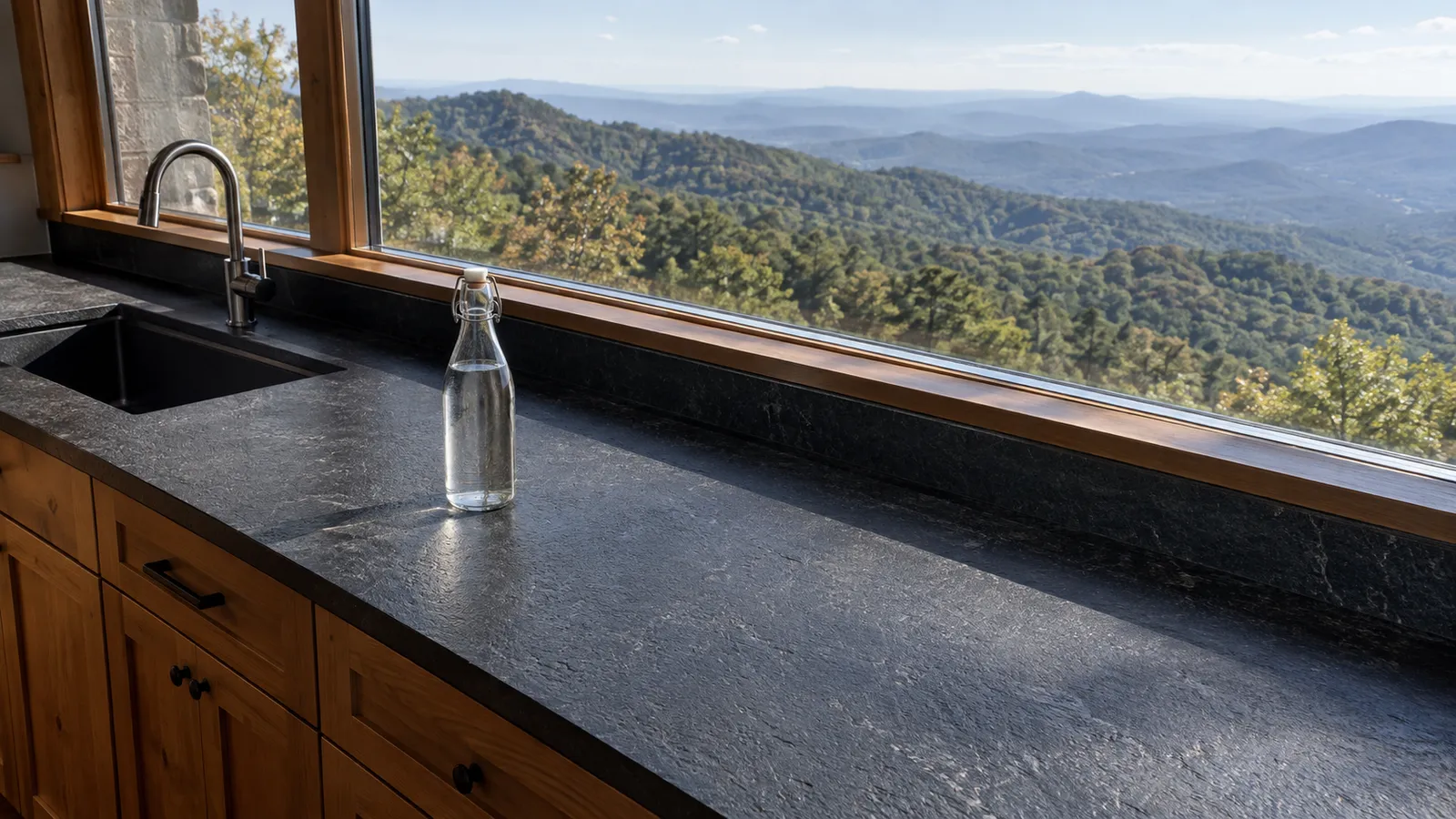
The polyester resins in engineered stone are not completely UV stable, and long daily sun can yellow or fade them. A west-facing window over the sink is a spot we talk through before you order.
Standard interior quartz should not be used outdoors at all. For a covered porch kitchen we point people toward porcelain or granite instead.
Quartz countertops in Henderson County are typically estimated at roughly $60 to $150 per square foot installed, with the brand and pattern of the slab, the edge profile and the number of cutouts moving the price most. A plain white or speckled quartz with a simple square edge sits near the bottom of that band, while a marble-look pattern whose long veins have to line up across the seams sits near the top.
For scale, a kitchen with about 40 square feet of counter would typically land somewhere around $2,400 to $6,000 in quartz before any extras.
These numbers are estimates, subject to change with slab prices and what the measure turns up, and the written quote we hand you after the free measure visit sets the final price.
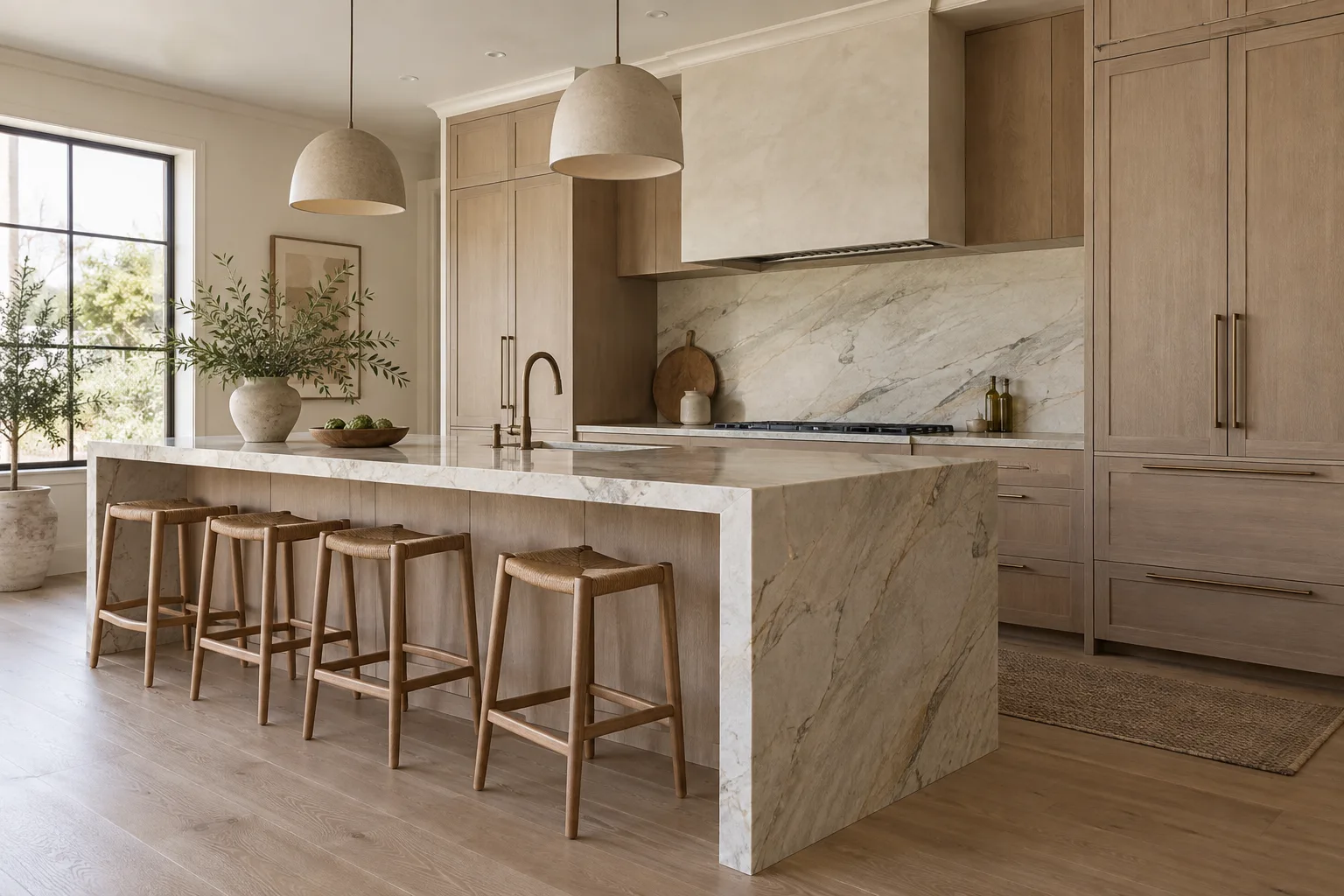
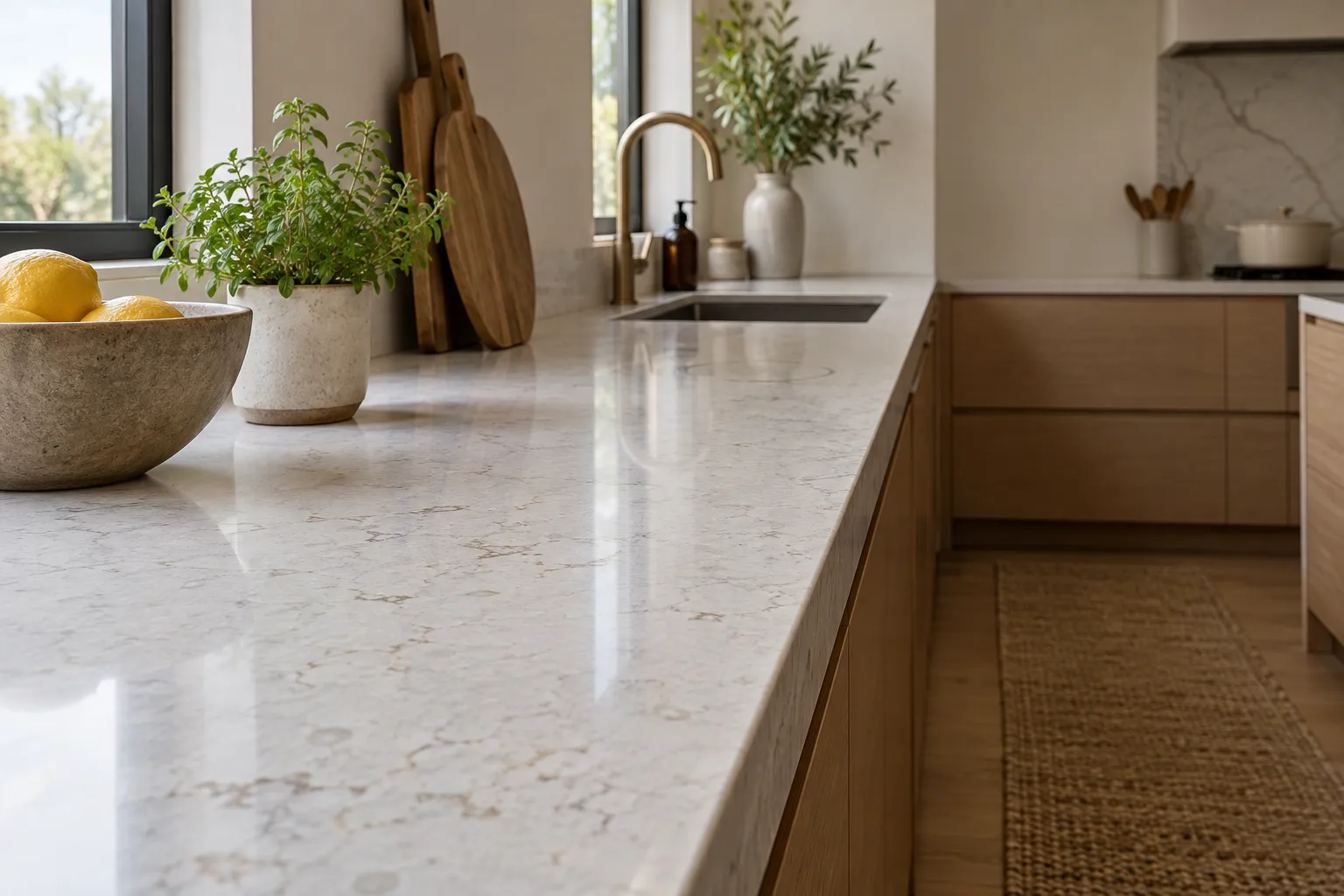
Consistency is the main reason people choose quartz: the slab that arrives looks like the sample you picked, because it is a manufactured surface rather than a quarried one. That makes quartz easy to match across a kitchen, a laundry room and two bathrooms in a single order, which a natural stone rarely allows.
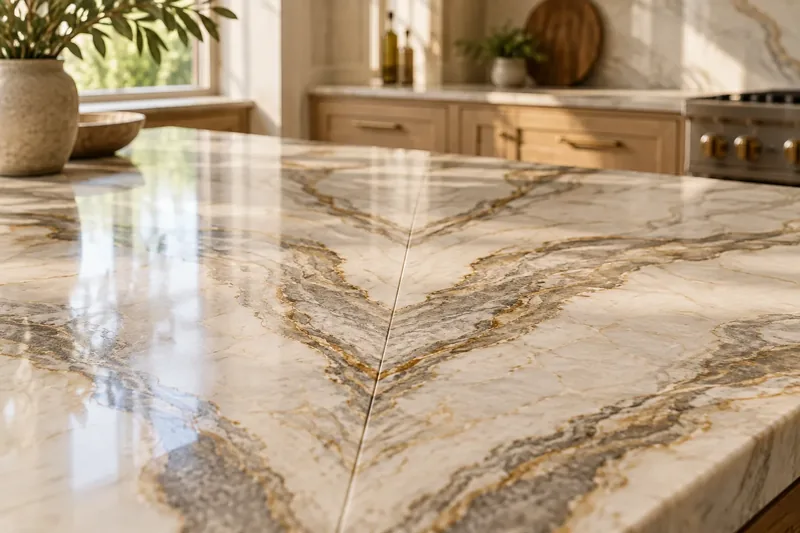
Solid and fine-speckled colors hide a seam well. Veined, marble-look patterns are harder, because a vein that stops dead at a joint gives the seam away from across the room.
So before any cutting, we lay out every seam on the slab, and on a veined pattern we show you where each joint falls and how the veins meet on either side of it. Seams are glued with color-matched epoxy and ground flush with the surface.
Seam location matters as much as seam look. We keep joints away from the sink and the cooktop wherever the room allows, and we avoid putting one across the seating side of an island, where elbows and plates find it every day.
We cut engineered quartz wet, in the shop, because the dust from cutting it is a serious health hazard. Breathing respirable crystalline silica causes silicosis, an incurable lung disease, and in 2026 OSHA and NIOSH issued a joint hazard alert aimed at workers who manufacture, finish and install stone countertops.
Engineered stone draws that attention because its body is mostly silica. About 500 workers at California quartz fabrication shops had been diagnosed with silicosis by January 2026, and Australia became the first country to ban engineered stone, from July 1, 2024. OSHA enforces two respirable crystalline silica standards, one for construction and one for general industry.
Here is what that means on your job:
A fabricator who cannot tell you how they cut quartz is telling you something. Ask before you sign with anyone.
Grandchildren, spilled juice and a counter that gets wiped twenty times a day. No sealing and no staining make quartz an easy fit.
A house that sits empty for weeks, or turns over between tenants, benefits from a top that needs nothing but soap and water between visits.
When the kitchen, the laundry and the baths should share one color, a manufactured slab keeps them consistent.
Anyone planning an outdoor grill station, or who sets cast iron down straight from the flame, is better served by another material, and we will say so.
Start to finish
Nothing is cut until you have approved the slab and the seam layout.
We measure the cabinets, check them for level, look at the carry path in, and talk through material, edge and sink.
You choose the slab, and we show you where the seams and the veining will fall before anything is cut.
The stone is cut wet, edged and polished in the shop, with openings cut to the sink and cooktop you picked.
We carry it in, set it, seal natural stone that needs it, and walk the finished counters with you.
Also from our shop
Where we work
Straight answers
No. Engineered quartz is non-porous, so it takes no sealer and resists staining from coffee, wine and oil without any treatment. Clean it with warm soapy water and keep harsh chemicals such as oven cleaner and paint stripper off it.
Not straight off the burner. Quartz makers advise against placing pots, pans or oven trays above 300 degrees Fahrenheit directly on the surface, because the resin can discolor or cloud. Use a trivet or hot pad every time.
Standard interior quartz should not be used outdoors. Its polyester resin is not fully UV stable, so sun can yellow or fade it over time. For a porch we steer people to porcelain or granite.
Quartz is typically estimated at roughly $60 to $150 per square foot installed, depending on the pattern, edge, thickness and cutouts. We measure first, and your written quote sets the final price.
The dusty work does not happen in your home. We cut, profile and polish quartz wet in the shop, which keeps respirable silica in the water, and any small trim on site is done with dust control.
On solid and speckled colors a well made seam is hard to find. On veined patterns you will see it more, so we show you each seam location on the slab before cutting and line the veins up as closely as the pattern allows.
It is easier in one way and stricter in another. Quartz never needs sealing, while granite may, but quartz has to be protected from high heat and strong daily sun, which the resin does not tolerate.
Plumbing is a separately licensed trade in North Carolina. A licensed plumber disconnects the old sink and reconnects the new one; we set the sink in the quartz and cut the faucet and accessory holes.
We measure homes and businesses across Henderson County. Builders and businesses can send drawings for a bid.
Licensed, bonded & insured. Calls only, we do not receive text messages.