Sun
Hours of sun through a west window or on an open deck will not yellow or fade porcelain the way sunlight can with a resin-bound surface.

Henderson Custom Countertops installs porcelain slab countertops in Hendersonville, NC, and is Henderson County's trusted specialist in thin vitrified slabs, specializing in modern kitchen runs, covered porch kitchens and bathroom vanities. We offer 12 mm and 20 mm slabs and mitered build-up edges.
Our team provides wet diamond-blade cutting, delivering a countertop that shrugs off heat and sunlight for both residential and commercial projects. The same crew that templates your cabinets carries in and sets the finished porcelain, so the people who measured every corner are the ones handling a slab that does not forgive rough handling.
From a 45-degree miter glued along the front edge to a last look at every outside corner, our team handles every detail. Serving Hendersonville, Laurel Park, Flat Rock and Fletcher, we give a thin slab the patient handling it needs, indoors or out.
Why Henderson Custom Countertops
Whoever measures your cabinets is the person accountable for the finished top.
Porcelain absorbs less than 0.5 percent water, the threshold the ISO 13006 standard uses to define it, so a porcelain countertop needs no sealer. Oil, wine and coffee stay on top until you wipe them away.
That low absorption is made in the kiln. Porcelain is fired at around 1,200 degrees Celsius, and in that heat the feldspar in the body turns to a viscous liquid glass that runs into the tiny pores and seals them from the inside. What comes out is a dense, chemically inert, frost-resistant slab, harder and more abrasion resistant than ordinary ceramic tile. Feldspar, for what it is worth, is one of the minerals the Spruce Pine district in the North Carolina mountains is mined for.
Modern slabs are big. Sizes of about 1,600 by 3,200 millimetres are common, which lets a long kitchen run go in with few seams, and it is also why a slab this large and this thin needs two careful people and a frame to move it.
One honest note on finish: a polished porcelain surface can carry microscopic pores opened by the polishing, and those finishes can take up a stain without a sealer. Ask about the finish when you choose, and we will tell you whether the slab you picked needs anything at all.
Porcelain is UV stable, heat resistant and frost resistant, and those properties belong to the fired body itself rather than to a coating, which is why it suits a sunny kitchen and a mountain porch alike. That matters here. Hendersonville sits at about 2,100 feet, and its mean daily low in January is about 26.5 degrees Fahrenheit, so water that works into an outdoor top freezes and expands again and again through the winter. A slab that takes in almost no water gives that freeze-thaw cycle very little to work with.
Hours of sun through a west window or on an open deck will not yellow or fade porcelain the way sunlight can with a resin-bound surface.
Porcelain resists hot pots and pans well. We still suggest a trivet, as porcelain makers themselves do.
For an outdoor kitchen, 20 mm is the thickness most makers recommend where freeze-thaw cycling puts stress on a top, and we confirm the product carries ASTM C1026 freeze-thaw testing before we specify it for a porch.
Porcelain slab countertops in Henderson County are typically estimated at roughly $70 to $160 per square foot installed, and fabrication labor, more than the slab, is what moves most jobs within that band. A thin slab means slower cuts, more careful handling and usually a mitered edge, and all three are shop time.
On a kitchen with about 40 square feet of counter, porcelain would typically come to roughly $2,800 to $6,400 installed before extras.
All of these are estimates and are subject to change; the written quote after your free measure visit sets the final price for the kitchen or the porch.
A porcelain slab is thin, so its edge is a design decision rather than an afterthought. There are two good answers: a mitered build-up that makes the slab look thick, or a crisp thin profile that lets it look as slim as it is.
Made for walls and decorative panels that carry no load. It is not a countertop, and it is too thin to miter.
The standard kitchen thickness at about 14 to 16 pounds per square foot, light enough for ordinary cabinet frames and thick enough to take a mitered edge.
About 25 to 27 pounds per square foot, made for impact, weather and outdoor use, and the one we point porch owners toward. A mitered edge joins a strip of the same slab to the front at 45 degrees, glued so the face and the edge read as one piece. It is how a 12 mm slab gets the look of a two or three centimetre top. The miter joint is a fragile point in fabrication, so it is cut and glued flat in the shop, never pieced together on your cabinets. Profiles you may know from granite, like an ogee or a full bullnose, are not practical on porcelain because the slab is too thin to shape. If an ogee is the look you want, a natural stone is the better choice.
Porcelain is the wrong choice where edges take hard knocks, where you want an ornate profile, or where a visible repair would bother you. On many porcelain slabs the pattern is only skin-deep, printed on the surface rather than running through the body, so a chip shows the plain color underneath and stays visible after it is repaired.
For a sunny porch, a modern kitchen with slim lines, or a rental that has to stay stain-free with no sealing, porcelain is hard to beat. At the measure we will tell you plainly which side of that line your job falls on.
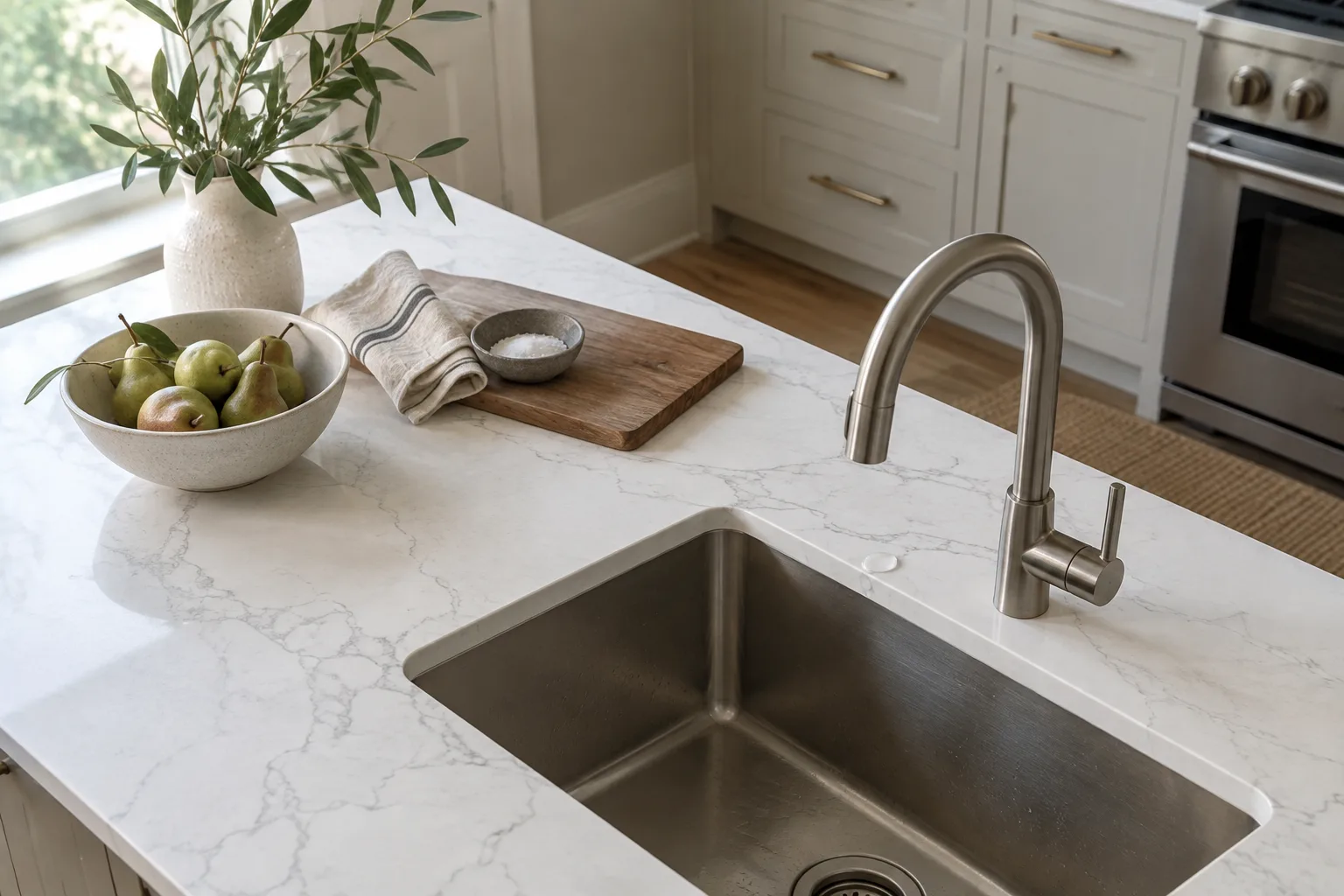
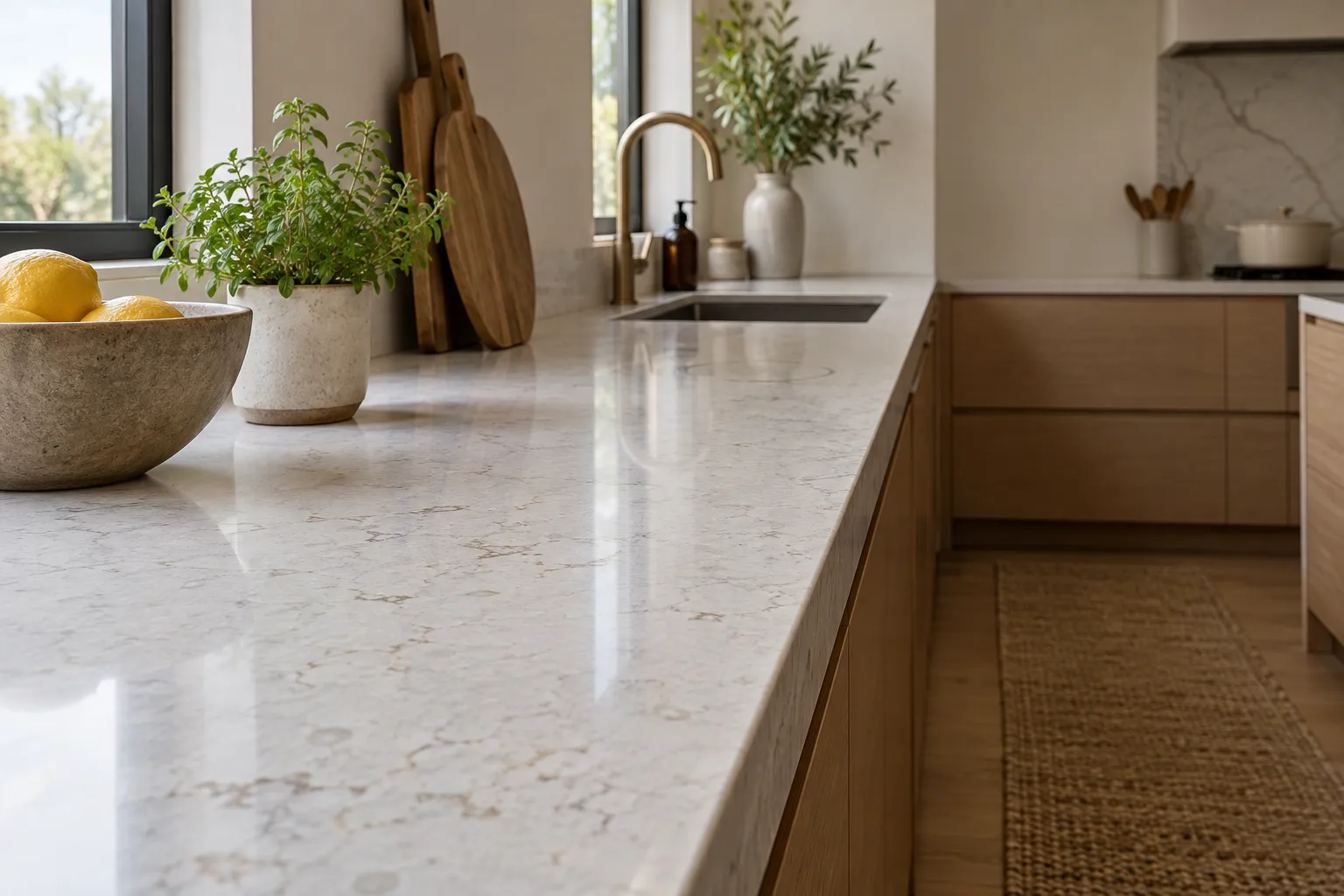
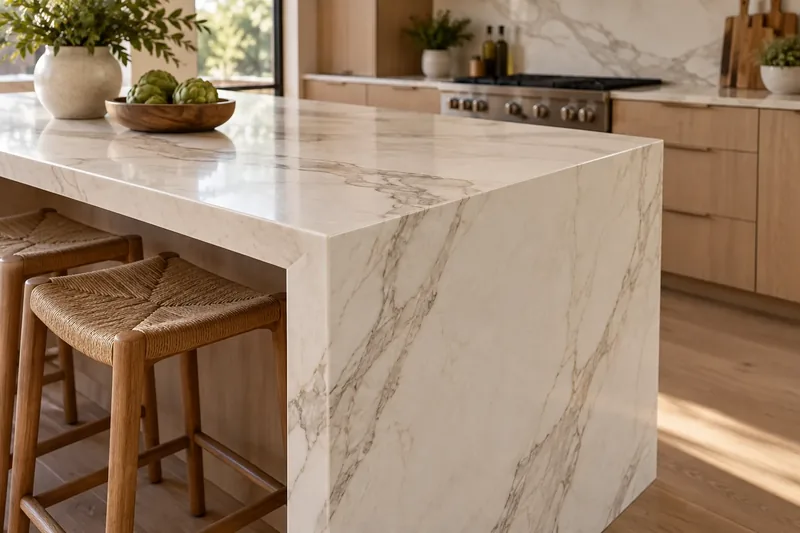
Start to finish
Nothing is cut until you have approved the slab and the seam layout.
We measure the cabinets, check them for level, look at the carry path in, and talk through material, edge and sink.
You choose the slab, and we show you where the seams and the veining will fall before anything is cut.
The stone is cut wet, edged and polished in the shop, with openings cut to the sink and cooktop you picked.
We carry it in, set it, seal natural stone that needs it, and walk the finished counters with you.
Straight answers
Most do not. Porcelain absorbs less than 0.5 percent water, so the body is effectively non-porous. Some polished finishes can hold stains in microscopic pores, so ask about the finish of the slab you choose.
Yes, and it is one of the best reasons to choose it. Porcelain is UV stable and frost resistant. For outdoor use we specify 20 mm slabs and check the product for ASTM C1026 freeze-thaw testing.
Usually 12 mm indoors, with a mitered edge to make it look thicker, and 20 mm outdoors. 6 mm slabs are for walls and panels, not countertops.
It can, mostly at edges and outside corners under a hard impact. Because the pattern on many slabs is printed on the surface, a chip shows the body color beneath and a repair remains visible.
Porcelain is typically estimated at roughly $70 to $160 per square foot installed, with thickness and edge work moving the price most. Once we have measured, the written quote for your porcelain job is what sets the final price.
Porcelain resists heat from pots and pans far better than resin-bound surfaces. Makers still recommend a trivet, and we do too.
Because gauged porcelain is thin and prone to breaking during cutting and carrying. It needs wet cutting, careful support and a crew that plans every lift, which is the work we build into the price.
Yes. We cut and finish the sink opening in the shop and set the sink. A licensed plumber makes the water and drain connections, since plumbing is its own licensed trade in North Carolina.
We measure homes and businesses across Henderson County. Builders and businesses can send drawings for a bid.
Licensed, bonded & insured. Calls only, we do not receive text messages.